

Stop Struggling With Dull Blades: The Best Way To Sharpen Kitchen Knives
We may receive a commission on purchases made from links.
As with most things, over time, knife blades quite literally lose their edge. Even though they're generally made from sturdy materials, such as carbon steel and stainless steel, every time you use a knife, you deteriorate its sharp edge. This isn't noticeable at first, but eventually, it's harder to get a clean cut while you're chopping ingredients on your cutting board. Often, you have to apply more force to get your knife to slice through; not only does this make chopping clumsy and lead to uneven cuts, it also makes it easier to injure yourself. That's why it's key to sharpen your kitchen knives regularly, before they get too bad. The go-to method for keeping knives sharp for many is a whetstone.
Whetstones, also known as sharpening stones, can be mined naturally from rocks or manufactured by mixing abrasive particles into sediment-like binders. Whetstones are awarded grit ratings, indicating whether they're more or less abrasive. Lower grit ratings are for sanding down damaged or chipped blades while finer grits can achieve more precise, final sharpening. By carefully dragging the blade of your knife along the stone's surface, the abrasive particles gently grind against its edge, restoring it to its original, sharp glory and making slicing and dicing a breeze in the kitchen.
Wondering why you can't just strike your knife against the rod that came with your knife set? These are actually honing rods, and while they can make your knife sharper, they don't actually sharpen it. Instead, they help straighten the blade out, eliminating any warping that may have occurred over time. Sharpening, on the other hand, grinds away the old, dulled metal particles, revealing a new edge of the blade.
How to use a whetstone (and how to keep your blades from dulling)
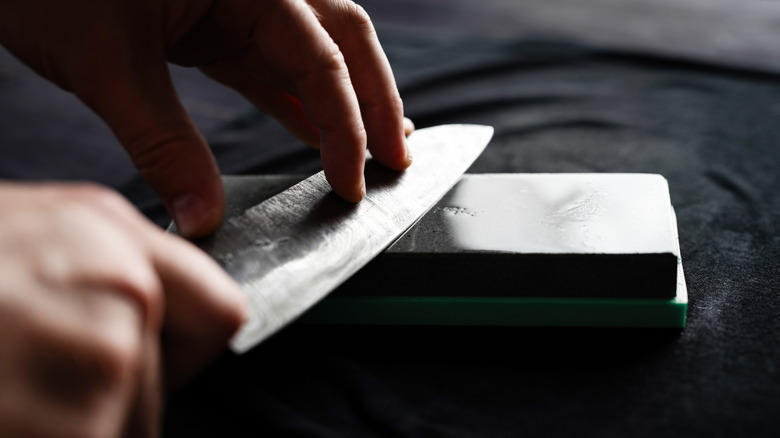
To use a whetstone, you need to soak it in water at least 15 minutes before you use it. Leave it longer if it's a particularly thick cut of stone since you want it evenly moistened. The water acts as a lubricant for your blade — just like you don't want to use a razor on dry skin, this allows for smoother drags, preventing further damage to your knife's blade.
After thoroughly cleaning and drying your knife's blade, hold it at a 15- or 20-degree angle against the stone with one hand on the handle, and one hand resting on top of the middle of the blade. Drag the knife down the length of the stone while slightly rotating it until it comes off the edge, being careful to aim it away from yourself. Do this until that side is satisfactorily sharp, then repeat on the other side of the blade. Double-sided whetstones have a coarser and finer side, so start with the coarse side and use the finer side to refine the edge. You can use the whetstone to sharpen kitchen knives, scissor blades, or even hunting and utility knives.
Whetstones do require some skill and technical ability to master. If this is outside your wheelhouse, you can take your knives to an Ace Hardware to be sharpened, or try a three-stage pull-through knife sharpening tool. To slow knives from dulling, there are some key steps to follow. For instance, even though you can technically put knives in the dishwasher, hand washing stops them from dulling as quickly. Additionally, chopping on hardwood cutting boards instead of glass, stainless steel, and other hard materials can help knives stay sharp.