

Find These Rare Bowls At The Thrift Store & You Could Be Sitting On A Small Fortune
For interior designers, collectors, or anyone who loves scoring a great deal, the ultimate thrifting thrill is spotting rare treasures priced at just a couple of dollars. Imagine scanning the shelves for hidden gems offering the perfect mix of charm and quirk when a delicate ceramic bowl catches your eye. That's exactly what happened to one savvy shopper who picked up two Otto and Gertrud Natzler bowls for $.99 each before later selling them for thousands. An Austrian-American couple whose celebrated work is highly collectable, the Natzlers created exceptionally thin and decadently glazed pieces renowned for their perfect proportions and luminous finishes. Identifying a Natzler requires a trained eye that can spot their fluid forms, experimental colors, and blocky signatures, but if you find one of their rare bowls at the thrift store, you could be sitting on a small fortune.
As any "Antiques Roadshow" fan already knows, there are many valuable collectible items you should never overlook, and according to David Rago of Rago-Wright Auctions, pieces of Natzler pottery are among them. When the expert appraised a collection of Natzler works during "Antiques Roadshow: Vintage Spokane," he explained that art pottery saw a significant decline after World War I and during the Depression, when it was prohibitively expensive for artists to make or decorate pieces by hand. Meanwhile, despite showing award-winning work at the Paris International Exhibition in 1938, the Natzlers were forced to flee Nazi-annexed Austria, eventually settling in a striking hillside home in Los Angeles where they lived and created for several decades. Rago extolled the Austrian duo's post-war influence saying, "They almost single-handedly resuscitated the pottery movement in the United States."
How to spot an authentic Natzler ceramic
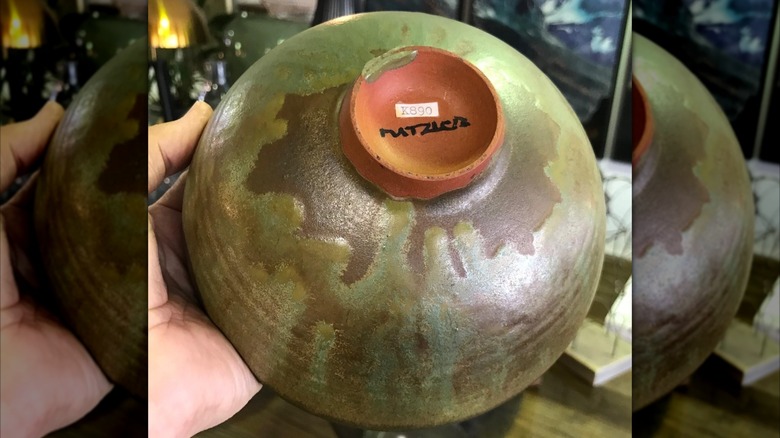
You'll need to know exactly what you're looking for to spot a Natzler piece in the wild. Unlike some contemporary ceramic makers who lean into bold and unusual shapes, Natzler pottery often seems deceptively simple at first glance. Look for rounded bowls and smooth plates with balanced silhouettes that feel nearly weightless. Gertrud Natzler was renowned for her exceptionally thin forms, so it should be easy to tell them apart from heavier mid-century ceramics on your local thrift store shelves.
The real magic, though, is in the glaze. As David Rago put it, "Otto was a glaze experimenter and kept playing with glazes and writing down formulas and developing these sensational glazes." The savvy thrifter who flipped her $.99 finds for thousands spotted pieces in calming yellow and blue hues, but more experimental crater-textured oranges, ox blood reds, and gunmetal blacks are also out there. Once you've spotted a promising piece, turn it over. Most authentic pieces are signed on the base with a blocky black stamp that reads "NATZLER," and may contain an archive number or small piece of red tape designating it as part of the couple's private collection.
Of course, when it comes to finding vintage treasures, condition really matters. Chips and cracks can dramatically lower a bowl or plate's value, even if it's authentic. But if you ever find a thin, beautifully glazed piece with that telltale Natzler mark hiding underneath for the price of a cheap coffee cup, buy it. The Natzlers' ceramics are held in major institutions including The Smithsonian. At auction and on the private market, they can command prices close to $100,000.