

Remove Stubborn Stumps Like A Pro: The Best Tools For The Job
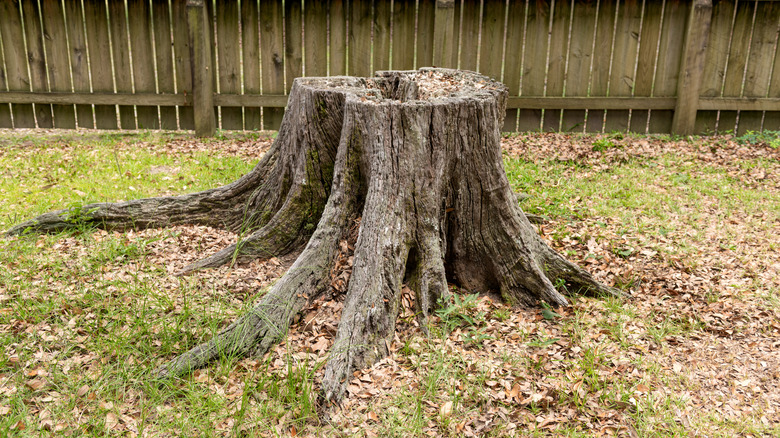
When is a tree stump not a stump? When a majestic old poplar becomes a windswept butte upon which children act out great king-of-the-hill battles, or when lesser stumps might be tables for truce talks, tea parties, or picnics. Unfortunately, they're more commonly just obstacles to mow around ... or, worse, traps that lie in wait to destroy your mower deck. Two things are consistent: Stumps aren't what we had planned for our yards, and they'll eventually rot away.
In an exclusive interview, Hunker asked John Snow, ISA Board Certified Master Arborist IL-1068 and Senior Urban and Community Forester at Tree CheckUp, LLC, what the best natural way to remove a stump is. He reminded us about that second consistent fact about stumps. "The answer to that is simply – time," Snow explained. "Stumps will naturally degrade over time."
Waiting for a stump to completely deteriorate can seem endless. Depending on the species and your climate, it might take a decade ... or half that, or twice that. Wood is dense, and by virtue of its roughly cylindrical shape, stumps don't present a lot of surface area compared to their mass. So it takes a while, but they will eventually rot. "That's precisely what happens in the forest as nature breaks down dead tree parts and naturally recycles them," Snow said. There are safe and sustainable ways of speeding the decomposition process up, and there's also the option of grinding the stump away mechanically. Otherwise, settle in and make the best of it. "Try putting a planter [on it] or turning the stump into a yard decoration," Snow suggested.
Grab a shovel and manure to speed up the process
Fun fact: Removing a stump with hand tools is so notoriously tedious that the video game Minecraft made stump removal one of the slowest "mining" processes in the game. In the real world, you can usually speed up wood decay considerably with the right tools and a healthy attitude about manure. John Snow, master arborist and 2025-2026 President for the Florida Urban Forestry Council, told Hunker exclusively that the path to encouraging a tree stump to rot away starts with making the situation friendly to the microbes that do all the work. "This can be accelerated by using composted manure," Snow said, "covering the stump to keep it moist, and encouraging fungi and microbes to break it down more quickly." But he warns that this still won't be a super-fast process, since small stumps will still take a few months or more and large ones considerably longer.
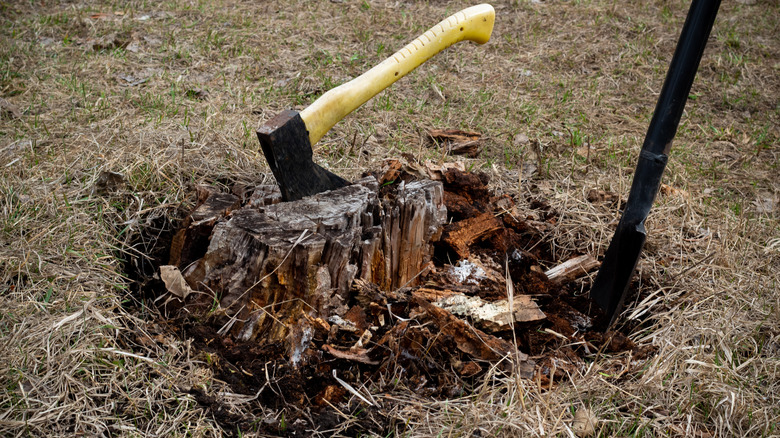
All that moisture and manure should make the process of DIY stump removal more manageable. At a certain point in the stump's slow conversion to nutrient status, you should be able to speed up the rest of the process a lot using a tool you probably already have around. "You will know it's time to remove the stump remnants once it becomes soft or brittle," Snow explained. "Then, using a simple shovel or axe, you can break it apart, dispose of it, and place some soil back to level off the area, or, hopefully, replant a new tree!"
Grinding isn't just for coffee, dancing, hamburger, grain, and Minecraft
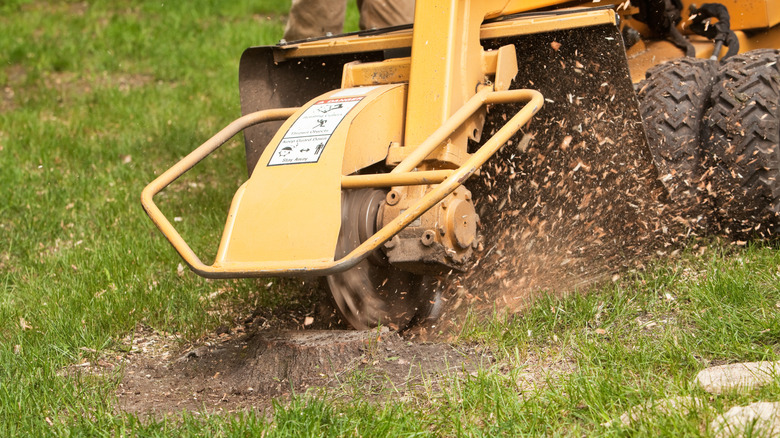
If you're impatient or tired of smacking your shins and mower decks on your stump, there's always the stump-grinding option. In an exclusive Hunker interview, expert arborist John Snow told us that you can either rent a stump grinder and do the work yourself or hire a pro to grind the stump for you. Snow cautions that there are some serious downsides to DIY grinding. "Stump grinders can be dangerous pieces of equipment," he said, "and flying stump parts can damage things, so it's not for the faint of heart." And if you don't invest in a machine of your own, the rental scenario has its own hazards. Snow explained that rented stump grinders are often not in peak condition, and dull grinder teeth make the process slower and more difficult. And they're not altogether inexpensive to rent, either. "Truthfully, you might spend just as much renting a machine as it would cost to hire a professional," he said.
On the whole, Snow said, renting a stump grinder and doing the work yourself isn't always the way to go. "Many local tree companies that have ISA Certified Arborists offer this as a service," he said. "Hiring a pro might cost a bit, but it's often the best choice, particularly for larger stumps."
Normally, that's where your stump journey would end. If you're cursed with a tree that comes back like the bad guys at the ends of horror movies — Bradford pears, for example — you might have more work to do to kill the roots and stump of the tree without digging them up.