

Fix A Door That's Sticking At The Top With This Cool DIY Trick
We may receive a commission on purchases made from links.
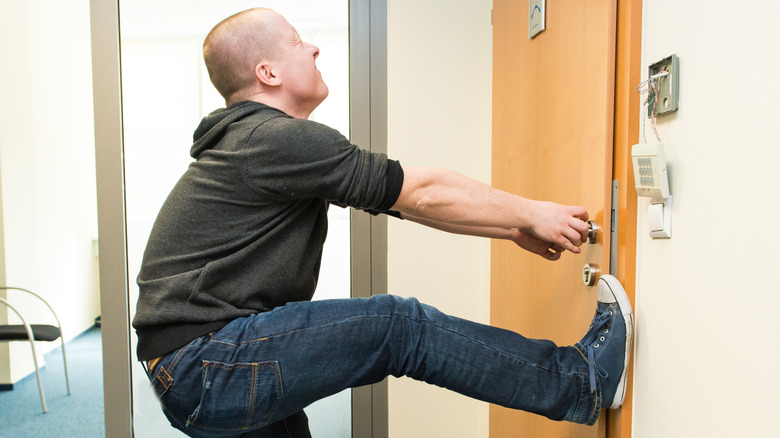
Here's a simple escape room puzzle for you. You're in a room where the door handle turns freely, but won't open. The only things in the room are an adjustable wrench, a small screwdriver, and a couple of popsicle sticks. You have 60 seconds to get out, and we'll tell you how.
Of course, a sticking door won't really trap you, though in times of super-high humidity, it might feel that way for a moment. Still, a sticking door just won't do. You can't close it quietly when the baby's sleeping. You can't sneak into the room and jump-scare your spouse or kids. And you can't properly slam it when you're irritated that someone jump-scared you. It really is quite an annoyance.
A door can stick for many reasons ... high seasonal humidity, foundation settling, poor installation, a warped door, wood rot, simple wear and tear, and others. The adjustable wrench trick has been around for a long time because it works for many of these problems, at least for a while. But note that if the hack doesn't work — or maybe even if it does — you should really determine the cause of the problem in addition to fixing the misaligned door. The potential seriousness of issues like foundation problems and wood rot demands that you find the source of your door dilemma, especially if it worsens or recurs.
Fix that sticking door with an adjustable wrench
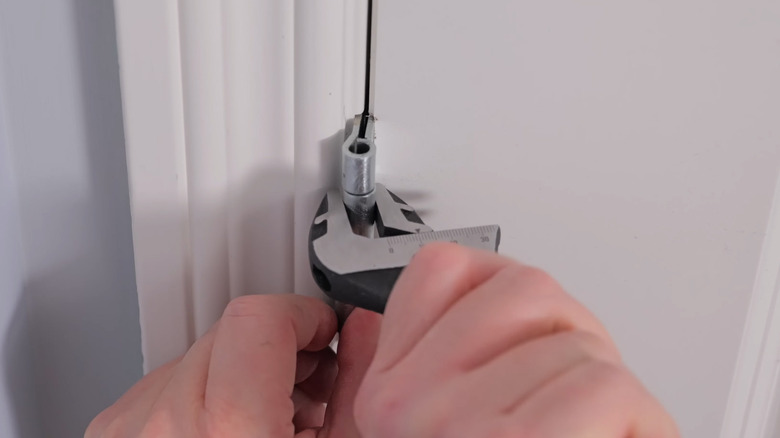
YouTuber @TheFunnyCarpenter posted a video in which he concisely explains how to make a hinge adjustment with an adjustable wrench. If your door is rubbing at the top of the strike jamb side (the side with the doorknob), he says all you need to do is remove the top hinge pin, then stick a shim — or those popsicle sticks — between the door and frame on the strike jamb side (not a permanent shim used directly on a door hinge) so that the door and frame are parallel. Finally, bend the knuckles on the door half of the hinge (the one you removed the pin from) until the pin holes line up with the pin holes on the other half of the hinge.
Throughout the video, @TheFunnyCarpenter uses a particular brand of adjustable wrench, but you don't have to use one for this hack. More than a few professional users of tools will happily tell you that adjustable wrenches are most useful when used as hammers. In recent years, the frustrating adjustable wrench has largely been replaced by tools like the Knipex pliers wrench, which transfers more force, stays adjusted, and has a number of other advantages. But a simple pair of pliers will do the trick just fine.
There are also commercially available products that do essentially the same work as the adjustable wrench method. The FastCap Knuckle Bender basically works the same way. There are also hinge and gap adjustment tools from Liffee and other brands that are meant to work without removing the hinge pin, and models that look like the Liffee tool combined with locking pliers.
Make the wrench hack even better with these tips
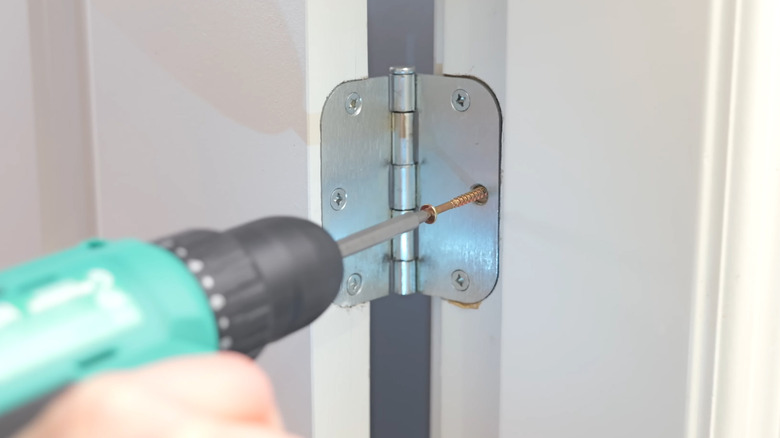
At 37 seconds in length, @TheFunnyCarpenter obviously can't get into the finer points of adjusting door hinges in his video, and there are a few that need to be discussed. Bending hinges is not, of course, a solution to whatever is causing the problem. And it isn't necessarily the first or only thing you should do. At a minimum, you should tighten all the screws in all the door's hinges and re-check the door. (If the screws won't tighten properly, you'll need to fix the stripped screw holes.) It's also a good idea to replace at least one screw in each hinge (on the frame side) with a 2.5-inch No. 8 screw. The additional length will allow the screw to pass through the jamb and into the wall's sturdier framing, which will make the door more difficult to break into and might very well pull the door into alignment on its own.
The hinge-bending itself might very well result in a slight misalignment between the door's hinges. That is, if they were all in a line (albeit not necessarily a perfectly vertical line) before the bending, they won't be all in a line afterward. This has a couple of practical effects. First, you should also remove (and adjust, if necessary) the pin in the center hinge, if your door has one. This helps to keep the two top hinges from fighting with each other and eventually causing the door to stick again. Also, note that this hack works best with inexpensive or lightweight hinges, and might be quite difficult to do with heavy-duty hinges intended for exterior or commercial doors.