

Erin Napier Ditches The Tile Backsplash Trend For Something More Unique

Erin Napier of HGTV's "Home Town" gives new life to homes with her husband, Ben Napier, in the small town of Laurel, Mississippi. Known for her passion to restore and highlight the unique character of historic homes, Erin designs her updated spaces with special custom details that elevate them beyond the average flipped house. Therefore, it should come as no surprise that when the Napiers bought their own 1930s country home just outside of town, Erin injected her signature attention to detail and charm into the renovation.
Among the many projects the Napiers tackled to make the gorgeous yet dated home feel like a little slice of rural European paradise was to give the kitchen a thoughtful refresh in a classic English country aesthetic. "I just want to be true to the architecture of the house," Napier tells her friends on Season 7, Episode 1 of "Home Town" as she gives them a tour of the property prior to the remodeling. With simplicity at the forefront of her design, Napier opted to forgo the typical tile or stone backsplash so common in today's renovations in favor of something with a little more historical country charm: a wood panel backsplash.
Napier selected a V-groove paneling to not only float between the countertop and upper cabinets like a typical backsplash, but to extend the detail out onto all of the kitchen walls to envelope the space. The result is a down-to-earth kitchen that feels both like it has been there forever and yet is fully updated, thanks in part to the backsplash material choice. Read on to learn more about V-groove material, the aesthetic it's suited for, and how to best incorporate it into your kitchen so that your space can have a unique, approachable look like the Napiers' English country home.
What exactly is a V-groove backsplash and where does it work best?
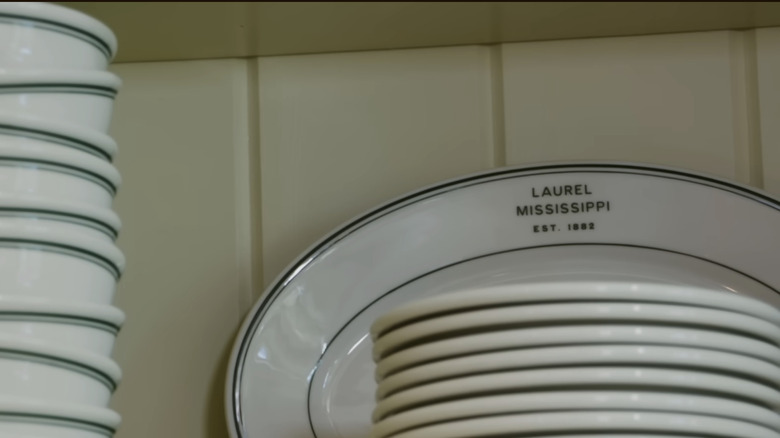
V-Groove is a type of tongue and groove wood paneling, which consists of planks that fit together with a notch that fits into a corresponding indentation on the adjacent plank. It has an angled edge that forms a V-shaped channel at the joint between planks, thus the name. Unlike farmhouse shiplap, which uses overlapping planks with a softer curved profile, or more ornate cottage-style beadboard, which is milled as a larger tongue and groove panel with raised vertical beads, V-groove is a slightly more modern, streamlined take on this charming traditional wood backsplash concept. On the other hand, it also feels less contemporary than a tile backsplash, further emphasizing the humble historical vibes.
V-groove wood planks have the unique ability to dance between updated and historical in the best way, making it a gorgeous option for a new or modern traditional aesthetic kitchen, which is all the rage right now. Its clean yet classic appearance toes the line between fresh and quaint in a way that other types of wood paneling cannot, as it's not pigeonholed into one particular style. This backsplash would also be right at home in any design aesthetic that features an old-school charm, such as farmhouse, cottage, rustic, vintage eclectic, Craftsman, Victorian, and European country (including French or English, like the Napier's country home), to name a few.
Tips for showcasing Napier's V-groove backsplash in your home
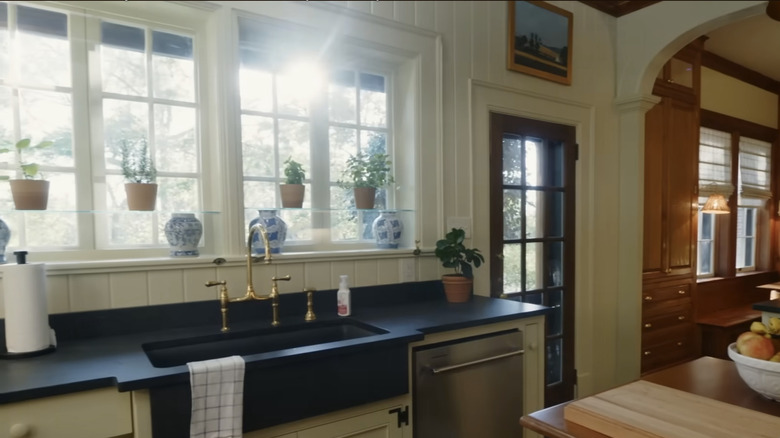
A gorgeous way to showcase a V-groove wood panel backsplash is to blend it in with the rest of the vertical surfaces by painting it the same color as the surrounding walls, adding a welcome layer of subtle texture and visual interest to the space while still letting other kitchen features, like cabinets and countertops, take center stage without competing. For example, Erin Napier's renovated kitchen takes this approach of wrapping the kitchen in one color of V-groove, and it complements the wood paneling in the adjacent sitting room beautifully. Alternatively, using V-groove to the height of the upper cabinets as a wainscoting on all walls is a beautiful option to make the space feel cohesive, as well as gives you an opportunity for a color change two-thirds up the wall if desired.
To ensure the practical success of a wood backsplash, it's important to note that the material itself is not waterproof. You'll see in the Napiers' kitchen that they used the countertop material for the first four inches of backsplash as a more durable barrier to take the brunt of the water contact. It's also important to use a satin or semi-gloss finish when painting your wood panel backsplash to provide a wipeable surface that's easier to clean than matte or eggshell wall finishes. A properly painted and sealed surface will protect it from contact with kitchen liquids and the realities of daily use, as well as make the woodwork pop aesthetically with a little sheen.
Taking the advice of Napier, who loved the look so much she used it in her own country home, consider a V-groove paneling backsplash for that perfect elevated yet lived-in, approachable country or historic aesthetic.