

Can You Use Vinyl Flooring In Your Garage? Here's What You Need To Know
We may receive a commission on purchases made from links.
Instinct probably tells you that vinyl flooring can handle pretty much anything you throw at it, including whatever you throw on your garage floor. Vinyl is, at least in part, the stuff your drain pipes are probably made of, and it should have no trouble with spills, a little humidity, or a hot day, right? However, everything is more complicated than it seems, and vinyl flooring not only has different characteristics than other plastics and even PVC, but the term "vinyl flooring" doesn't even describe a single thing. Every type will work for a garage floor in the right circumstances, and none of them will work in the wrong circumstances.
Different types of vinyl flooring, unsurprisingly, have different qualities and purposes, and there are a few of them. At a minimum, you have luxury vinyl plank (LVP) and tile (LVT) flooring, sheet vinyl flooring, and vinyl composition tile (VCT). Figuring out which are acceptable for a garage floor means grokking how each handles the common problems associated with garage spaces: heavy loads, wild temperature fluctuations, and uncontrolled humidity and moisture coming up through a concrete slab.
Because "vinyl flooring" means so many different things, you'll occasionally see flooring companies recommending against using the particular types of vinyl they sell (often click-lock LVP) in garages, without regard to how other types of vinyl perform. For example, you might sometimes read that LVP (possibly just called "vinyl") can be sensitive to chemical spills, expands and contracts mercilessly with temperature changes, won't stay glued down in high humidity, and will just slip right out from under a car.
What vinyl flooring can and can't handle
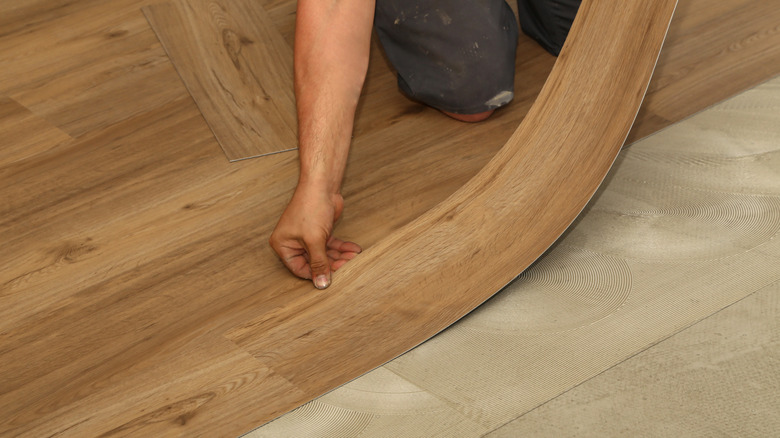
But the truth depends on many factors, like the composition of the flooring and how it's installed. For example, LVP can usually handle the weight of a personal vehicle, but might struggle with heavier equipment. Ted Cook of Really Cheap Floors says that stone polymer core (SPC) LVP flooring is perfect for garages, while it might be best to avoid a wood polymer core (WPC) LVP floor, which is softer and more prone to dents. He warns that turning the tires of a stationary car parked on LVP might cause click-lock LVP planks to separate.
On the other hand, LVP tends to have firm limits when it comes to temperature and humidity ... somewhere in the neighborhood of 30-70 percent relative humidity and 55-100 degrees Fahrenheit. In garages with a lot of windows, solar gain can cause sudden and dramatic temperature increases that stress an LVP floor. And installing a floating LVP floor on concrete can make it necessary to use waterproof planks or a moisture barrier. To help with moisture from concrete subfloors, consider a waterproof surface membrane (WSM), applied either as an epoxy resin or as a sheet membrane, to which your vinyl adhesive is applied.
Like vinyl itself, the adhesives used to install it make a big difference in what a floor can handle. In a garage, it's best to use adhesives tolerant of high temperatures and fast temperature shifts. Acrylic-based adhesives typically handle high temperatures and temperature fluctuations and are impervious to moisture. All adhesives should be installed when the floor is dry and within the temperature range specified by the adhesive manufacturer.
The best vinyl flooring options for a garage floor

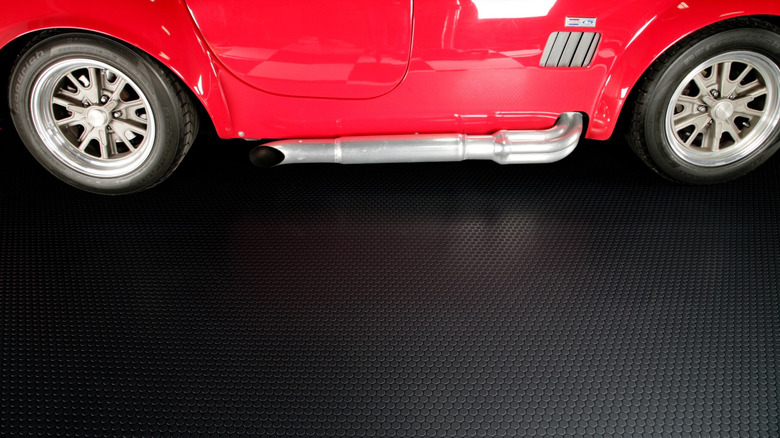
But all those downsides are the worst-case scenario, usually for LVP, and there are other options. There are many garage-specific vinyl flooring products, and sheet vinyls like Levant vinyl universal flooring are not susceptible to any of the common restrictions for vinyl flooring, other than the need to use vinyl-safe chemicals when cleaning them, and can be installed as floating or glue-down flooring.
Then there is VCT flooring, an option that's often used in commercial settings for many of the same reasons you might use it in your garage. VCT is cheaper and lasts longer than LVT/LVP, can be restored by occasional polishing, unlike other vinyls, and is manufactured with limestone and thermoplastic binders to be extraordinarily durable.
Again, it does matter how a vinyl floor of any stripe is installed. In general, glue-down compares favorably to floating vinyl plank flooring since it resists movement and improves a floor's ability to handle heavy loads. And a clean, dry, and level concrete floor will always have the best chance of accepting adhesive properly.