

These Colorful Symbols On Homes Have A Deeper Meaning Than You Think
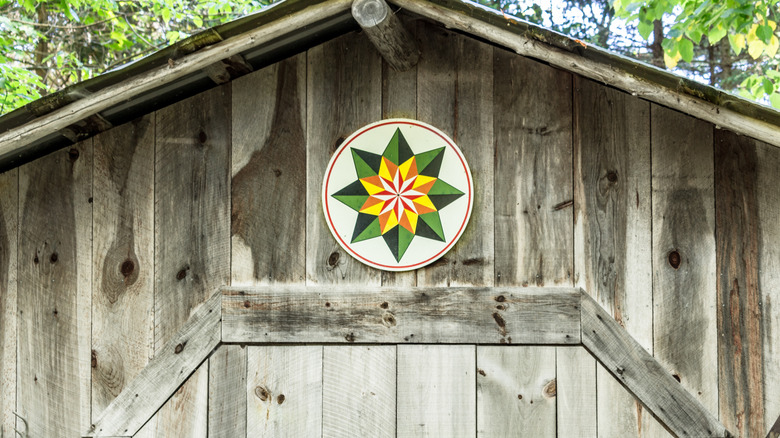
If you're lucky enough to have visited some parts of Pennsylvania Dutch country, you'll be familiar with what historians call "hex signs." These are large, often colorful, usually geometrical, and always striking decorations painted prominently on the region's barns. Speaking exclusively with Hunker, Patrick Donmoyer, director of the Pennsylvania German Cultural Heritage Center at Kutztown University, tells us about hex signs, how they came to be, and what they might mean.
Donmoyer has long been on a personal mission to document the barn decorations of Berks, Lehigh, and the surrounding counties, and he has tracked down over 500 such barns in the area — a number that he says is increasing. The fact that they continue to be painted and repainted helps to explain this growth, and it also illuminates the fact that residents think of their barn stars as at once prized and ordinary.
If these elaborate folk-art badges aren't what you first thought of when you read "barn star," that's understandable. Donmoyer sees a common heritage between the Pennsylvania Dutch hex signs and the stars people put on their houses and sheds — and, yes, barns — nationwide. "There seems to be an association in the American imagination with stars and barns, and the earliest examples of painted stars are among the Pennsylvania Dutch," Donmoyer says. "This art form became extremely popular in the early 20th century with the rise of tourism, and is likely to be a major source of inspiration for the tin stars." Perhaps it is natural that these community and faith-oriented symbols should eventually be transmogrified into a universally loved way to bring farmhouse style to porch decorations.
The deep history of a relatively young art form
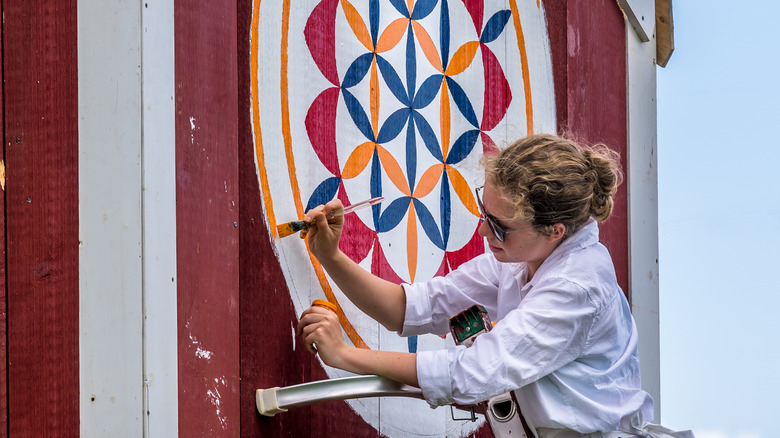
Speaking to Hunker, Patrick Donmoyer elaborates on a barn star tradition that's much more richly faceted than modern store-bought tin stars. "My research and historical vernacular architecture is based on another type of barn star," he explains, "which is the term that was widely used to describe the circular geometric painted murals produced by the Pennsylvania Dutch that are also referred to as hex signs." The term "hex sign," Donmoyer says, was an invention of a travel journalist that originates from only around 100 years ago, but the area's barn decorations — Scheier-Schtanne, literally "barn stars" — date to the first half of the 19th century or earlier, with roots traceable to the late Middle Ages.
Before these symbols decorated barns, they were used on household objects; writing for the Glencairn Museum, Donmoyer says that he's found them on "chests, butter-molds, coverlets, spoon-racks, spice-boxes, cheese-presses, tape-looms, rifles, powder horns, musical instruments, trivets, and wood-working tools." Hex signs' main motifs are folk-art patterns representing celestial entities and geometrical renderings of flowers, abstractions that are often fused into rosettes combining radial petal patterns with the rays of stars. Donmoyer documents similar motifs adorning everything from birth announcements to stylized flowers on headstones. These private markings later transformed into large, highly visible ornaments on barns and other buildings.
Originally, though, they drew from similar yet much older European building decorations, in much the same way that folk art and European fine art influenced both the iconic arts and crafts and art nouveau styles. And it's here that we begin to find hints of meaning.
Searching for meaning among Pennsylvania Dutch barns
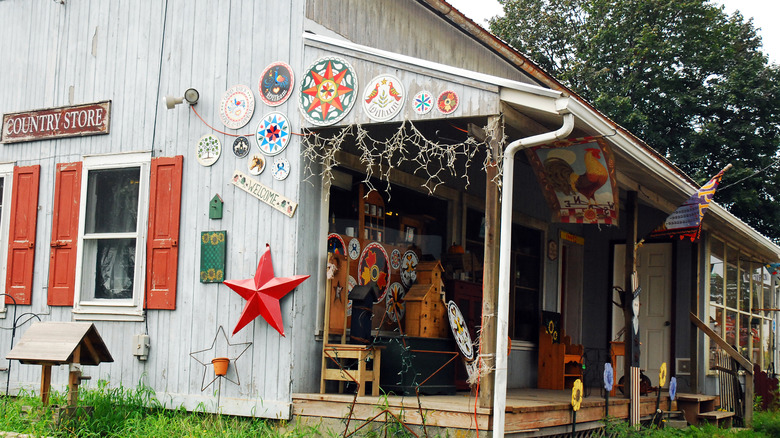
The phrase "hex sign" refers to the supposed protective magical intent of barn stars, and this was played up by those with a stake in the region's tourism. Figures like Johnny Ott, self-styled "Professor of Hexology" and not coincidentally the owner of a hotel, happily cultivated the mythology of the hex sign and its ostensibly quaint magical, superstitious, and sometimes fabricated meanings and origins.
But the symbols' actual origins aren't entirely alien to these purposes. Donmoyer has traced the roots of hex signs to the integration of "architectural blessing inscriptions in Europe," as well as to earlier Pennsylvania Dutch house blessing boards and plaques. These blessings were intended to encourage divine protection of a dwelling and inspire "righteous living" within. Evolving from older European and colonial traditions, these hex signs linked celestial imagery to religious beliefs. There are also close and natural associations between celestial hex signs and the navigation, mapmaking, and timekeeping of the day. After all, many barn stars resemble nothing so much as the compass roses, sometimes called compass stars, which are used to orient maps to the four cardinal directions.
Some find meaning in the elevation of the ordinary by art. Others might see these hex signs as markers of the Pennsylvania Dutch ethnic identity in the New World. Perhaps, though, this tradition isn't about merely elevating mundane objects and buildings, but infusing them with the heavenly, as befits a devoutly religious community. Of course, the actual meaning of hex signs is likely to be some mixture of all of these traditions, as a stubbornly cohesive community is occasionally tinted by changing times.