

Why You Should Avoid Running Your Dishwasher When It's Storming At All Costs
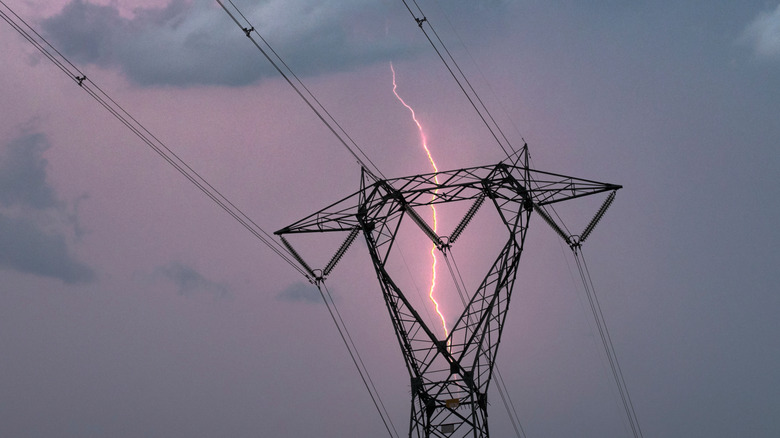
You don't need to be Ben Franklin to know that lightning is a powerful surge of electrical current. According to the U.S. Centers for Disease Control and Prevention (CDC), there are roughly 40 million lightning strikes in the United States each year. Sure, there's a one in more than a million chance of you being struck by lightning, but that doesn't mean lightning can't strike power lines, sending surges of electricity running through the electrical grid and into your home. Running your dishwasher during a thunderstorm isn't as dangerous as standing on your roof holding a golf club, but it's not a smart thing to do, as it can destroy your dishwasher.
If you can hear thunder, that means that there's lightning in the area. Lightning can be as many as 10 miles away from the center of a thunderstorm and still be dangerous. Power lines and grids are vulnerable targets to lightning. A study published in the journal npj Climate and Atmospheric Science notes that lightning strikes can account for around 40-70% of powerline failures (though other sources show that this can vary). When there is a power outage as a result of a lightning strike to the grid, this could mean a surge of electricity running to your house, which can damage or even destroy anything you have plugged in or hardwired to your home's electricity, including appliances like dishwashers. And if your home receives a direct strike, the effect will be that much more powerful. So, how can you try to prevent this from happening?
Protecting yourself and your dishwasher during a thunderstorm
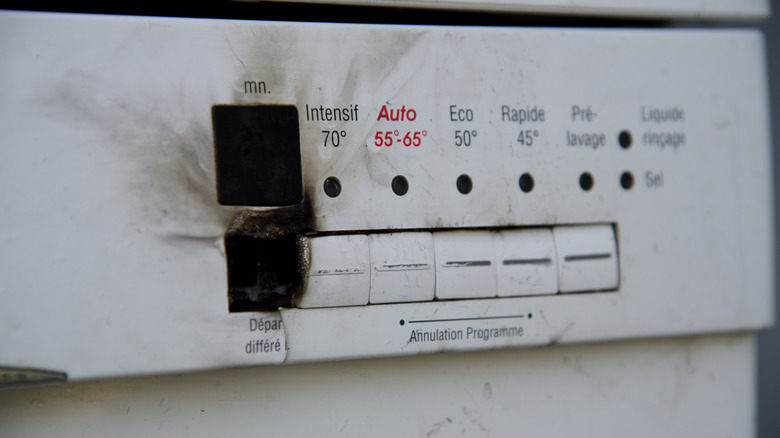
Unlike portable appliances that you can simply unplug, most dishwashers are hard-wired into the home's electrical system. Since you can't unplug it, the safest thing to do is to cut off power to your dishwasher from the main electrical panel in your home. Since that likely also cuts off power to your refrigerator, that might not be something you want to do. The second-best thing to do is not to run your dishwasher during a storm. Dishwashers, on average, use around 1,500 watts of power while running, and any power surge can overwhelm the sensitive circuits in their electronics.
Running water through your dishwasher doubles the trouble because water and the metal in the pipes through which water runs conduct electricity. Just as you shouldn't take a shower during a thunderstorm, keep away from your dishwasher, even if it's not running. And don't opt for washing dishes by hand rather than using the dishwasher. Your faucets are most likely made of metal that can conduct electricity as well. You, metal, water, and lightning are a dangerous combination.
If you live in a state that's prone to lightning strikes, such as Florida or Louisiana, you might consider adding a lightning rod to protect your home. Lightning rods work by diverting surges of electricity into the ground rather than into the home, but they're not always able to divert 100% of a lightning bolt's electricity. Even with a lightning rod, it's safer to keep your dishwasher off during a thunderstorm.