

The Simple Tip That Makes Drilling The Perfect Pilot Hole A Breeze
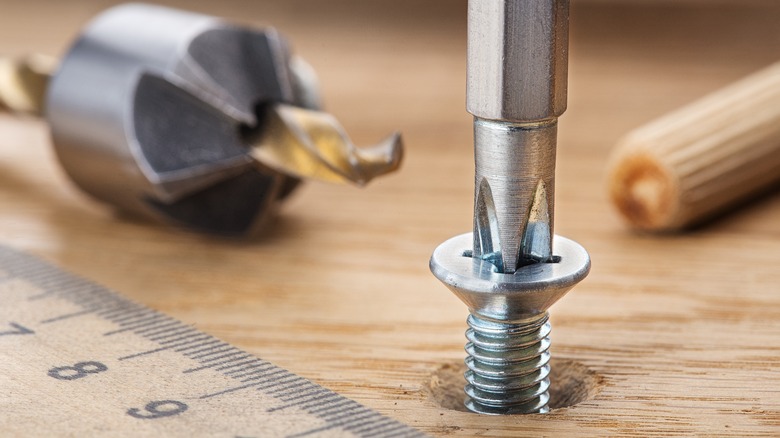
Drilling at an angle understandably gives woodworkers, particularly novices, the heebie-jeebies. This is a technical term describing the anxiety produced by having to do something that you know, based on experience, isn't going to go well ... or at least isn't going to be nearly as simple as you'd like it to be.
The problem isn't so much finding and drilling at the right angle (with a little practice, you'll figure out how to get the angle right). The real trouble is that, without one specific little piece of advice, angled pilot holes will torment you every time you attempt one. Drill bits have a tendency to wander or walk on the face of an unblemished workpiece. That is, when you apply pressure with the drill or press, the bit changes location very slightly. This is particularly noticeable when drilling at an angle, and it can be a pain when those angles need to be somewhat precise. Ready to be saved? Here's the tip: Drill a straight, perpendicular hole before you drill the angled hole.
A pilot hole is, of course, a hole that you pre-drill in order to make a later screwing or drilling operation go more smoothly. It might seem a little silly to drill a pilot hole for your pilot hole, but don't think of it that way. Instead, think of your straight starter hole as a kind of more involved center-punching. Center-punching is the process of creating a small dimple on your workpiece that will guide the point of your bit when you start drilling. The point finds the depression, which holds it in place until the bit starts cutting.
What if a pilot hole had a pilot hole?
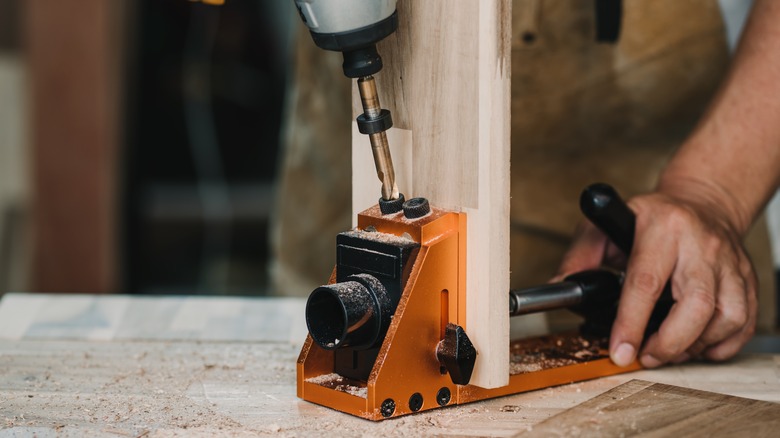
The trouble is that a typical center punch doesn't create enough of a dimple to guide a bit that's approaching at an angle and is really prone to being pushed out of position. What you need is a precisely located and deeper "center punch," and the way to get it is to drill your workpiece shallowly at a 90-degree angle. To do this, use a bit that's substantially smaller than your pilot bit. You just need something big enough to guide the tip of the pilot bit. For woodworking and carpentry, the ideal is to use a brad-point bit that essentially has a smaller bit built into its tip. But you can certainly use separate bits instead.
As always, there might be other reasonably good solutions. You will be tempted to use a drill press if one is available to you, and with a brad-point bit and a shallow drilling angle, it might work. But depending on a lot of factors — the hardness of the material being drilled, the types of drill bits you're using (and their length and rigidity), the runout of your press' drill, and so on — a drill press bit can wander as much as a handheld drill's can. A clamped jig is often a good tool for precisely locating angled holes. Consider, for example, jigs designed for drilling pocket holes; without their assistance, your pocket holes would almost certainly wander all over the edge of the pieces you're joining.