

5 Genius Hacks That Make Removing Stubborn Stickers From Glass A Breeze
We may receive a commission on purchases made from links.
Maybe you still have your college car, and have finally decided to remove the 27 Jamiroquai stickers. Ot your 16-year-old is finally ready to remove those 10-year-old "Frozen" stickers from her mirror. Or maybe you just want to remove price stickers from some dishes or glass photo frames. The very thought fills you with dread, as memories of sticky fingers and chemical residue rise to the surface from the last time you tried this.
But there is a way. At least five ways, in fact, and they don't have to be annoying or terrifying. For the most part, these strategies all work the same way: you undermine the adhesive, then scrape the sticker it off. There are, of course, extremely effective sticker remover chemicals available. And you may have seen a video of a man sticking toilet paper to a bit of duct tape, spraying it with Un-Du sticker remover, then simply peeling the toilet paper off. But you probably don't need the expense of a new product or the delay while waiting for delivery. Most of this stuff can probably be found in your cupboards somewhere. But remember that these solutions are specifically for glass; removing those "Frozen" stickers from your walls is a whole other topic.
Scraping with a razor blade
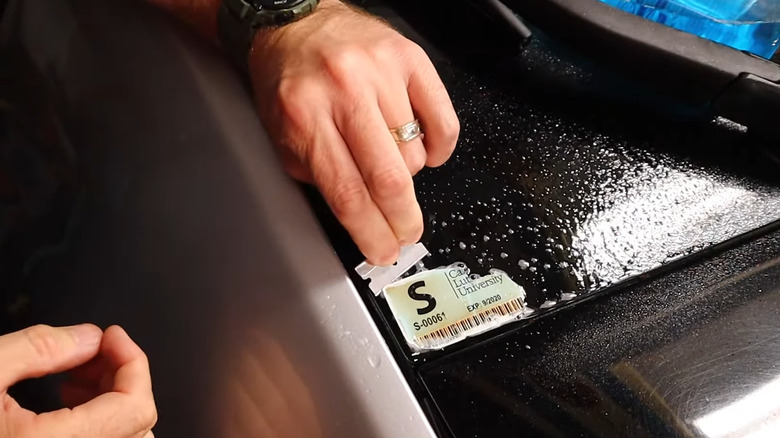
This may seem a little obvious, but at least a little scraping will usually be required to remove stickers, and razor blades are uniquely suited to the task. Scraping with razor blades is often most helpful as the mechanical step used in conjunction with other techniques for making the sticker adhesive let go.
Clean the sticker and the area around it, then saturate the sticker with glass cleaner or whatever liquid you're applying to loosen the glue. If your plan is to have the blade do most of the work, you can start scraping right away, since the liquid mostly functions as a lubricant to make the blade move smoothly across the glass.
It's pretty common to hear that you should scrape at a "shallow angle" of about 45 degrees. The problem is that this isn't a shallow angle. A better (and far more shallow) angle for scraping glass is 10 to 30 degrees (that is, there's a 10 to 30-degree angle between the blade and the glass). Pull the sticker away as you scrape, and don't be alarmed if there's glue residue left behind. This is called a "cohesive failure" of the adhesive, meaning that the glue fails to stick to itself. The residue can then be removed from the glass with another application of cleaner and another pass with the razor blade.
Peanut butter with or without chunky abrasives
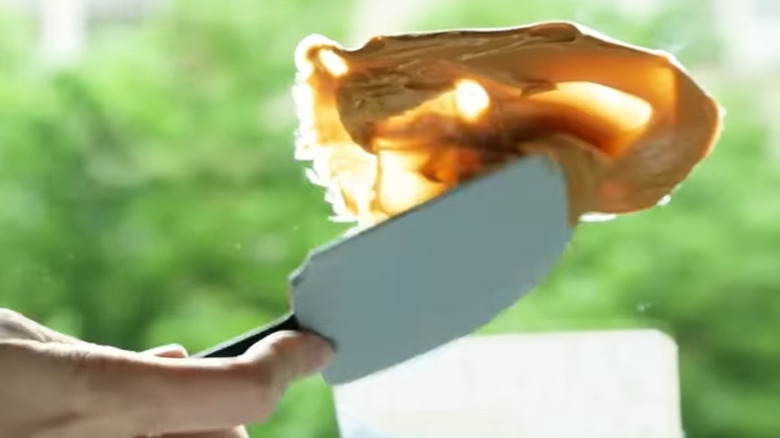
Now, on to the good stuff. And the good stuff, in this case, can be chunky or creamy. Yes, we're asking you to consider spreading peanut butter on your window, mirror, jar, or whatever. It's a time-honored way to break down most adhesives. Just apply the peanut butter and wait a bit; how long depends on the sticker material, the adhesive, and other factors. You might need to experiment, but because the oil won't evaporate, longer is probably better. Then use your scraper (presumably a razor blade), to remove the peanut butter, sticker, and adhesive ... usually in one pass.
This works because the hydrocarbons in peanut oil cause the sticker's glue to soften and lose adhesion. It works with most sticker adhesives, but not with nitrile rubber-based adhesives, polyurethane adhesives, and some epoxies. As you work, the oil also forms a barrier between the glass and the adhesive, preventing the sticker's glue from re-adhering, which can often happen with more volatile solvents. And, yes, other oils will usually work just fine for this, but peanut butter comes in a convenient paste form.
Heat gun or hair dryer
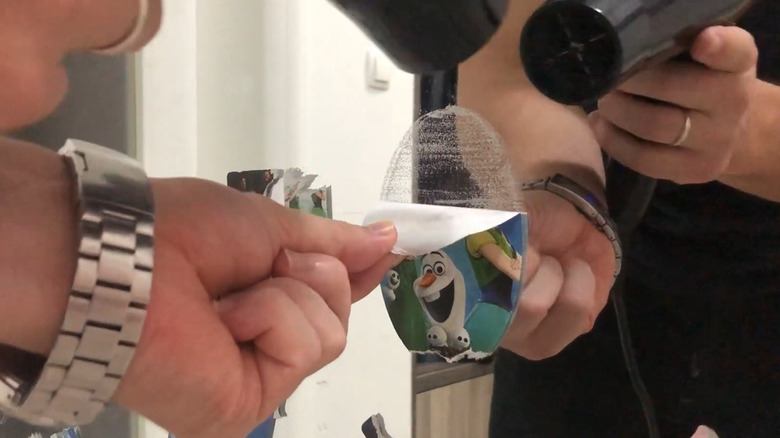
Chemicals (and compounded chemicals like peanut butter) aren't the only way to make glue let go. You can also make adhesives lose that adhesive feeling by applying some heat. It's important to note that this approach can release fumes into the air if you use too much heat, so it isn't necessarily safer than the chemicals ... and definitely not safer than the peanut butter.
The usual way to do this is by using a hair dryer to loosen the adhesive, then scraping away the sticker. Do these steps one at a time; don't ever put your hand in front of a heat gun. There's a pretty good chance you'll still end up using a solvent to remove the glue residue even after heating it, but the hair dryer can definitely speed things up. This technique is often used to loosen adhesives when replacing broken phone and tablet screens. You can also use heat again during the second pass for getting rid of any remaining residue.
Glues are weakened with heat either by increased fluidity of an adhesive or by crystallizing the adhesive, causing it to become brittle and lose strength. The heat can come from anywhere, as long as there's enough of it. If you don't have a heat gun or a hair dryer, you could even try a clothes iron covered in a cloth.
Insect (and sticker) repellent
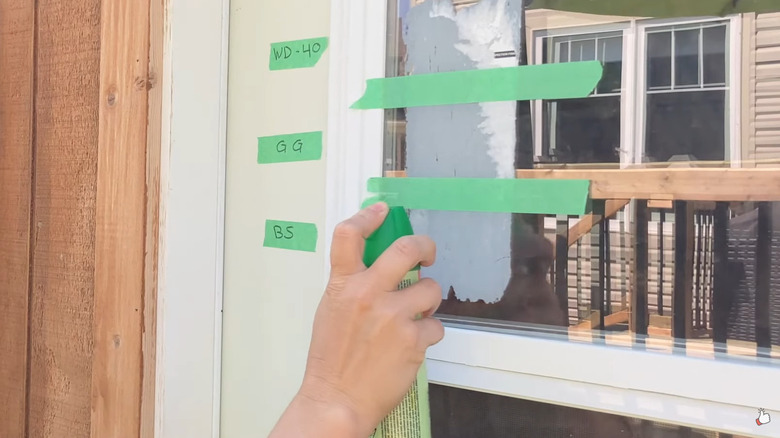
Didn't see this one coming, did you? But using bug spray — specifically, insect repellents that contain the chemical DEET — to remove stickers from glass turns out to be something people occasionally do to great effect. Just spray on, wait for a bit, then scape it off with the implement of your choice.
This isn't as kooky as it might sound. DEET, a chemical developed for use by the U.S. Army in 1946, is actually a solvent that does the same work on sticker adhesive as any other. The only catch is that DEET is such a powerful solvent that it will dissolve things you'd rather keep solved, like rubber, plastics, and some fabrics. So watch where you spray it, and stick to the glass itself if possible.
Any DEET insect repellent will work, such as Deep Woods Off (which is marketed as dry, "not oily or greasy," which might be either an advantage or a disadvantage for sticker removal). Either way, this talk of using more DEET brings up one more little catch with using the chemical: some warn that it is a neurotoxin, and should be avoided. But the EPA has done safety reviews and found it safe to use if you avoid cuts, wounds, eyes, and mouths. Glass should be okay.
Steam and a razor blade
Water is known as the universal solvent not because it can dissolve anything, but because it dissolves more things than any other solvent. One of the things it doesn't dissolve well is sticker glue, so using steam to remove stickers is probably successful by virtue of the heat applied, or the combination of water and heat. And if the water in steam doesn't do a particularly good job of helping with the glue-loosening, it will help with lubricating the area so a razor blade can scrape away the sticker and residue.
Heat makes many solvents more effective. Most solids and liquids are more soluble at higher temperatures, but that doesn't mean you want to go vaporizing solvents in the same air you're breathing. In fact, this trick is best left for steam. To illustrate the potential issues, consider acetone, which happens to be a good sticker-remover, and can even be used to remove paint. But heating acetone increases the chance that it will catch fire, poison you, dissolve the container you have it in, or all three.