

The Best Way To Get Rid Of Spurge Weed To Prevent It From Becoming A Bigger Issue
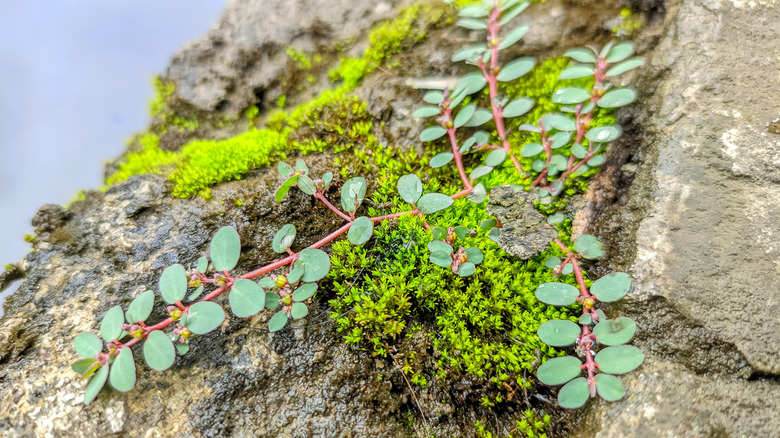
Spurge weed (Euphorbia) is a native annual indigenous to the eastern U.S., but found in many parts of the country. And although we often associate growing native plants with being the more ecologically-friendly alternative to planting non-indigenous species, spurge weed is an example of a plant that is simultaneously native yet incredibly invasive. With common varieties like the spotted spurge (Euphorbia maculata) and prostrate spurge (Euphorbia prostrata), this plant is a creeping weed that's known to take over the surfaces on which it grows. It particularly thrives in open areas, like pastures, thinning lawns, pavement with cracks, and garden walls. Additionally, certain varieties are considered poisonous to dogs and other domestic and wild animals. So, what is the best way to get rid of it?
First, let's learn more about it. A summer plant, spurge weed grows in thick, radial mats (earning it another nickname, "spotted sand mat") with stems that are pinkish-red in color and with small, pear-shaped leaves. It is notorious for growing in nutrient-poor soil, but it easily establishes and spreads, taking over yards and sidewalk spaces and then into garden planters and lawns. Given its prolific presence, it behooves any gardener or homeowner to halt the spurge weed in its tracks. However, that may be easier said than done since some varieties of spurge are herbicide-resistant weeds with a strong taproot. If left unchecked, spurge weed has significant consequences for your yard space, but with consistent care, it is possible to eradicate this matting plant for good.
The most effective way to kill off spurge weed
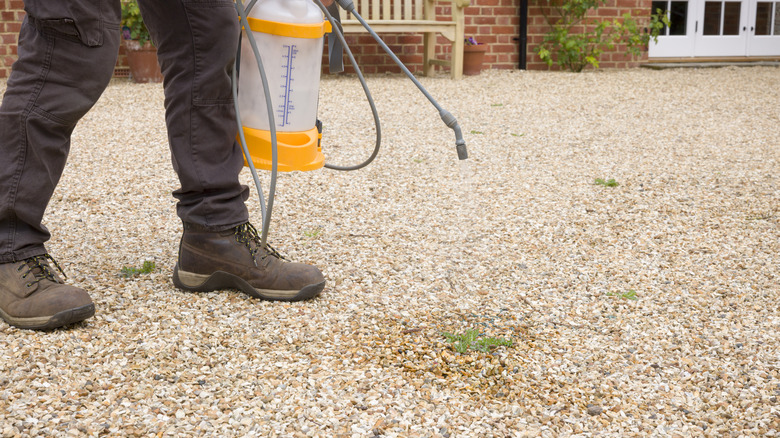
Spurge weed is, unfortunately, tolerant to some of the more common ways to get rid of weeds. You can't mow over it, for example, since it grows so close to the ground that mowers don't have a chance to rip it up. It's also difficult to remove large amounts by hand since it rapidly emerges and leaves viable seeds and roots in the ground. It also contains a distinctive, white sap that's known to irritate exposed skin, adding another challenge to manual removal. The most effective way to banish these weeds, then, is a dedicated scheme of pre-emergent and post-emergent herbicide schedules, rather than one-off sprays.
For pre-emergent herbicides, products with dithiopyr, pendimethalin, prodiamine, or isoxaben are key to eradication. Spray these herbicides in late winter before the soil gets too warm to give the seeds a chance to germinate. The problem is, pre-emergent sprays will not be very effective against weed clumps that have already grown through to the surface. Therefore, for post-emergent herbicides, you'll want to find sprays that contain 2,4-D (a substance effective against broadleaf weeds) used in combination with ingredients like 2,4-DP, dicamba, triclopyr, or sulfentrazone, among other chemicals.
It's possible to prevent spurge weed infestations in your yard with a few tricks, too. First, consider adding mulch to your beds and planters; this strategy prevents germination because it smothers out necessary light. Second, if you notice an errant small clump, do try manual removal, but be sure to wear gloves and dig the plant out, root and all, as soon as it emerges. Lastly, care for your lawn so it grows thickly; be mindful of the height of your grass and water deeply to help your lawn stand a fighting chance.