

Why Is My Gas Stove Burning Yellow And Should I Worry?
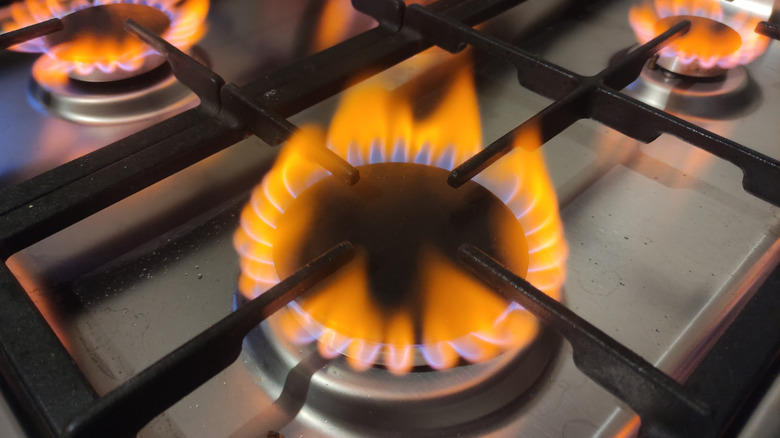
A few minutes with a low-and-slow barbecue aficionado or a wood stove devotee is all you need to understand how much there is to learn about flames. And while ribs that fall off the bone or a seemingly never-ending fire are great, the flame secrets a gas stove technician has to share might be the most counterintuitive and the most important for your well-being. After a childhood of drawing yellow-orange flames, you might see those colors when you ignite your gas burner. You think, "That looks about right." A gas stove expert, on the other hand, might very well say something like "Turn off your gas now. I'm on the way." Let's unveil what exactly a yellow flame might mean on your gas cooktop.
A yellow flame is not one of the more common problems with gas stoves, and not every yellow flame on a gas stove is an emergency. A yellow or orange flame is a sign of incomplete combustion, and it has a number of causes that boil down to your stove using the wrong ratio of natural gas or propane to oxygen; either too much gas or too little oxygen. Whatever the cause, there are good reasons to be concerned that there might be dangers, including carbon monoxide.
If you're appropriately concerned now, let's take a quick step back. This is something you need to figure out right away, but it could literally be caused by something as simple as a spill or dust, flour, or some other particles keeping your burners from working efficiently. The problem is almost always fixable, and usually, you can at least diagnose it yourself. So, when should you be concerned and what should you do?
What to do when natural gas burns yellow
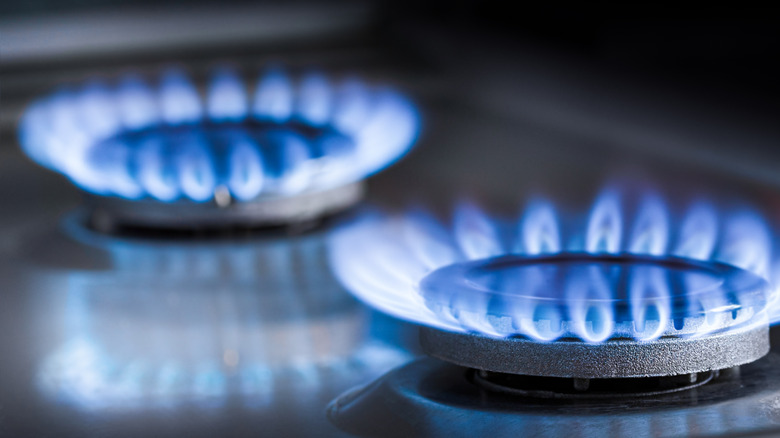
Regardless of whether you have a natural gas or propane stove, the steps for figuring out the cause of a yellow flame start the same way: Turn off your gas, look for the simplest explanations first, and clean as you go. Make sure your burner cap is properly seated. If that doesn't fix the yellow flame, remove the grates and burner caps and then clean the burner itself. Use an old toothbrush or other soft brush (or you can use a pin or vacuum) to clean the burner ports. Use the brush to clean the igniter electrode if your stove has one. The next step is to clean and, if necessary, adjust the air shutter that controls how much air is allowed in to mix with the gas. For some models, you can carefully make this adjustment while the burner is on, so that you can see the results of your changes. You'll need to consult the manufacturer to see if this is a feature on your range.
If none of this works, it's time to explore other potential causes. There are a couple of questions to keep in mind as you proceed. Is this a new problem with a stove you've had for a while? If it is a new stove, have you recently changed anything about how the stove operates? If your stove has suddenly developed this new problem, turn off any nearby humidifiers, which can cause a yellow flame. Make sure your kitchen has adequate ventilation, especially if you've changed anything related to airflow. Allow fresh air to replace the air extracted by your vent hood. And consult your gas supply company, as impurities in the gas can contribute to yellow flames.
Why propane burns yellow
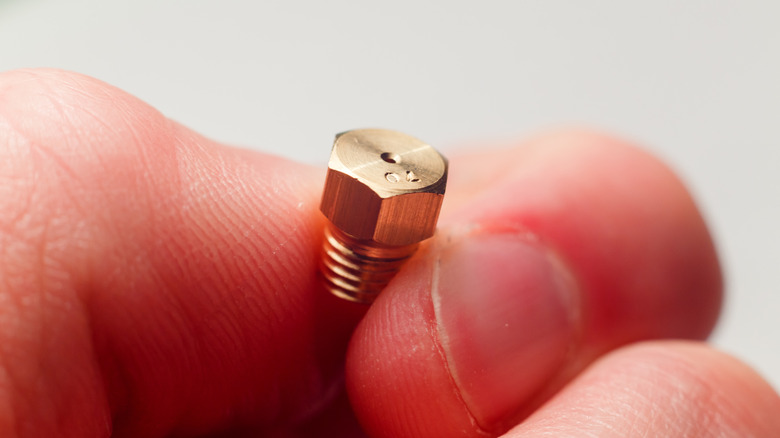
Certain types of gas stoves work differently. In addition to all the possible causes, a propane stove with a yellow flame has a few other issues to sort out. If you have a new (or new-to-you) propane stove, or you've recently converted from natural gas to propane (LP gas), there's another important avenue of investigation to travel down. Properly set up stoves handle natural gas and LP gas very differently. Propane has more than twice the energy of natural gas and is delivered under more pressure. As a result, natural gas stoves are not designed to handle LP properly unless some critical changes are made. These include a new or properly adjusted pressure regulator and have properly sized jet orifices for propane rather than natural gas. Other adjustments to gas and/or air flow might also be necessary; consult your specific model's documentation.
Left unadjusted, burning propane in a natural gas stove is incredibly dangerous. This will produce a very high, often yellow flame and will produce an unacceptable level of carbon monoxide. It can also result in delayed ignition or backfiring, which often results in an unpredictably sized flame at an unpredictable location ... including inside gas lines, which can lead to fire or explosion.
In some very limited circumstances, vintage stoves can be adjusted for propane without the need to buy (or have someone fabricate) new orifices. This is a specialized process that involves modifying gas flow with an adjustable orifice and balancing that with the air shutter's intake. Again, this approach only applies to some vintage gas stove models. If you feel you're out of your depth in trying to fix whatever is going on with your stove, it is important to discontinue use until you have a professional take a look.