

The Old-School Gardening Technique That Will Help Your Plants Thrive
If you live in a drought-prone area or you have a busy schedule, it can often be difficult to stay on top of watering your plants. In addition, having beds at ground level can leave you with back or knee pain as a result of frequently bending over to tend to your flowers and vegetables. However, there is actually an ancient gardening system that solves both of these problems — and many more!
Hügelkultur is a technique that has long been used in European countries and was first mentioned in a gardening book in Germany in 1962. The essence of this unique gardening bed is to create a mound out of decaying organic matter, mainly wood, which releases vital materials such as phosphorus and nitrogen as it decomposes. These substances then feed the plants growing on top, allowing them to absorb not only the nutrients but also the rainwater they collect, too. It's a bit like having a thriving forest floor right in your own garden! This technique is excellent for starting a vegetable garden, but it is also handy for flower beds as it can add height to your landscaping and will not require as much watering, if any.
How to build a Hügelkultur bed
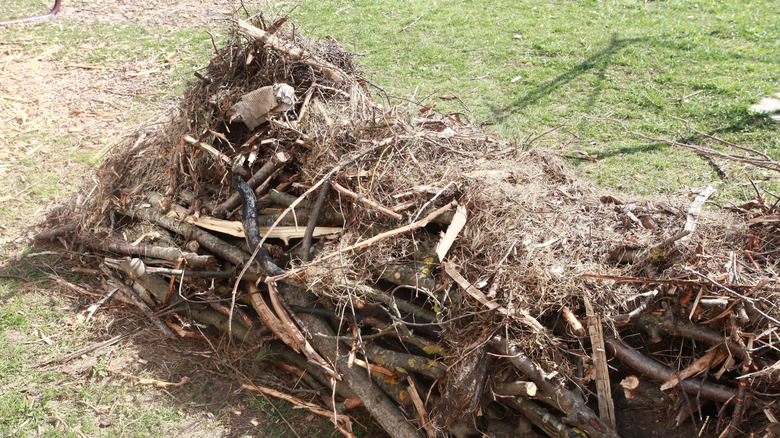
To create your own Hügelkultur bed, start by preparing the ground. Clemson University's College of Agriculture, Forestry and Life Sciences recommends digging a trench about 2 or 3 feet deep, then covering it with a few inches of cardboard. This will not only work as a safe and natural weed control for your bed, but it will also make the area appealing to earthworms, whose tunnels aerate the soil and allow for better drainage. You can then begin laying your wood. It is a good idea to place larger pieces on the bottom to help create a sturdy foundation and increase the moisture retention at the base.
Then, add on alternating layers of wood and other organic matter like grass clippings or compost. The mound can be anywhere from 2 to 6 feet tall, but keep in mind that it will sink slowly over a period of years as the materials underneath decompose. Water the mount well, then you can top it off with soil, compost, and some mulch. Keep in mind that if you've elected to use freshly-cut wood, the timber will suck nitrogen out of the soil for the first year or so, rather than adding it back in. To avoid this, you can either use wood that has already begun to decompose or you can select plants that will enrich the soil in your garden, such as peas (Pisum sativum) and beans (Phaseolus vulgaris), which produce their own nitrogen. Remember that the base of the Hügelkultur bed will have the most moisture, so it is a good idea to put plants that require more water, such as lettuce (Lactuca sativa), spinach (Spinacia oleracea), and squashes, at the bottom.