

We Asked Experts If Lemon Thyme Really Repels Pests, And They Gave Us The Truth
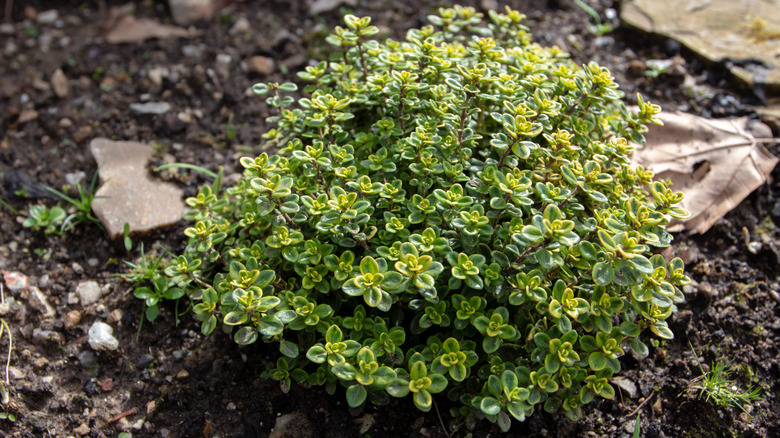
Wouldn't it be great if you could abandon spraying chemicals around your house or garden to keep pests out? What if there was one plant that you could grow that created an invisible barrier against pests, smelled nice, produced pretty flowers, and could withstand periods of drought and high heat? And (perhaps best of all) one that was easy to grow? Lemon thyme (Thymus citriodorus) is often touted as that plant. This delightful herb is certainly no fuss to grow, and the scent of lemons is often used as an insect repellent. But there's not a lot of direct scientific evidence out there that lemon thyme works – only hints – so we sought out the advice of two gardening experts. They told us not to jump to conclusions.
In an exclusive conversation with Hunker, Dr. Gary Bachman warned against viewing lemon thyme as a cure-all for your pest problems. Bachman, a retired horticulture specialist at Mississippi State University's Extension Service, told us: "A single lemon thyme plant sitting on the patio table will not have any appreciable effect. Now you'd be talking if the patio is surrounded by 1,000 square feet of lemon thyme." One thousand square feet is about half the size of a tennis court!
We also spoke exclusively with House Digest's master gardener Tiffany Selvey, who said she loves lemon thyme, but qualified that "the scent really isn't that strong, even when you crush the leaves." She added: "I have tried using [lemon thyme] for pest control in my garden and fresh leaves rubbed on my body, with no noticeable effect." Sure, there's a lot of anecdotal evidence that lemon thyme works, but don't rely on that alone when looking to grow pest-repelling plants.
Some alternatives to lemon thyme to repel pests

There are alternatives to lemon thyme that may be more effective in repelling pests. You can grow the plants in your garden or, if you know how to extract essential oils and scents, use them as a repellent spray. Lemongrass (Cymbopogon citratus) isn't a low-growing ground cover like lemon thyme, but it's a better repellent of termites, cutworms, whiteflies, mites, aphids, and other pests. Plant lemongrass in full sun and moist, well-draining soil. Lemongrass is an annual that is only hardy in USDA hardiness zones 8 to 11, so look for perennials if you want longer protection against pests.
Wild mint (Mentha arvensis) is a North American native perennial that's a known pest repellent. The only problem is that it's an aggressive spreader, so keep it in pots if you want to grow it in your garden. Wild mint is hardy in zones 3 to 8 and repels many pests, including termites, aphids, houseflies, and others. Plant it (in pots) in full sun in well-draining soil. Catnip (Nepeta cataria) is registered with the U.S. Environmental Protection Agency as an insect repellent, as it is effective against black flies, mosquitoes, cockroaches, bed bugs, and other pests. Catnip is a perennial that grows easily in zones 3 to 9. It needs full sun but can tolerate part shade. Lavender (Lavandula angustifolia) is a lovely-smelling plant that humans and pollinators both enjoy, while the essential oils it releases can deter termites, mosquitoes, aphids, and ticks. Lavender is hardy in zones 5 to 9. You can grow lavender in a pot or plant it in well-draining soil in full sun or part shade. Just don't over-water it.