

If You See A Tree Painted Purple, Don't Ignore It — Here's Why
We may receive a commission on purchases made from links.
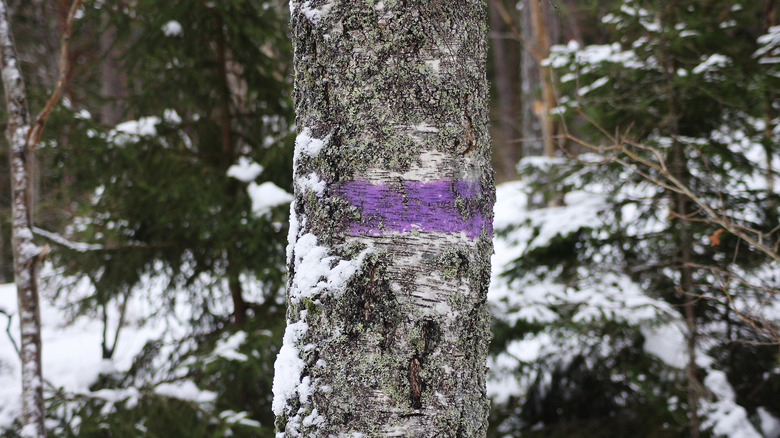
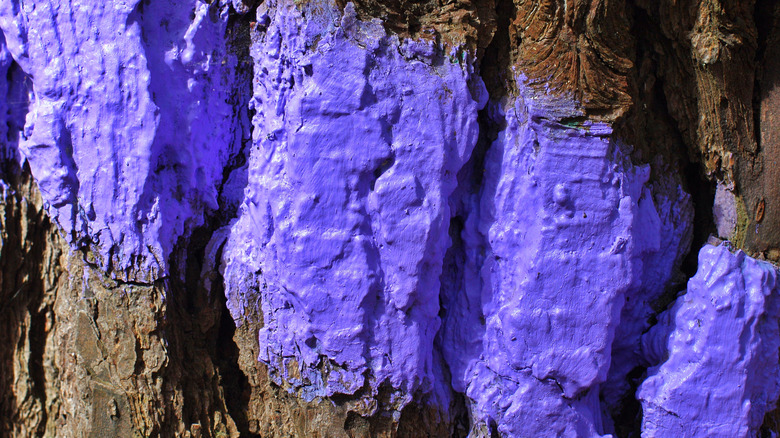
Exploring backcountry locales can be a fun pastime, but in certain states around the country, a tree painted purple along your path may spell trouble. In fact, it may actually mean you're the one who's in trouble with the law. In recent years, many jurisdictions now allow land owners to paint the trees along their property boundaries purple to mark property lines and indicate that you are indeed trespassing. Rather than put up those "private land" or "no trespassing" signs of yore, the purple paint is meant to communicate the same message. While in many cases these "purple paint laws" are aimed towards deterring hunters, fishers, and trappers from doing so on private property, wandering onto the land parcel without the owner's permission still constitutes trespassing.
Why purple paint as the new universal warning sign? First, maintaining physical signage can be an arduous task. With weather and other outdoor elements at play, signs can get damaged or fall, making them less than effective at keeping strangers out. Since paint can last longer than signage, it's much less upkeep, and property owners don't have to worry about finding the best place to place security signs. Second, painting large swaths of trees is much more budget-friendly than putting up a sign at each and every turn. Purchasing signs over and over again, particularly for replacements, can become a costly affair, so paint is a great, inexpensive alternative. Lastly, purple is the color of choice for its vibrance. It stands out against the typical canvas of colors in nature, and even colorblind folks are able to see the purple, making it an effective visual form of communication.
Watch out for purple paint in these states
Almost two dozen states have purple paint laws, and in recent years, several states have more strictly codified the practice. Virginia, Alabama, Arkansas, Florida, Illinois, Indiana, Iowa, Kansas, Kentucky, Louisiana, Maine, Missouri, New Hampshire, North Carolina, Pennsylvania, South Carolina, Tennessee, Texas, and West Virginia all have purple paint laws aimed to deter illegal hunting and trespassing. Other states like Utah, Arizona, Idaho, Montana, Nevada, Nebraska, and Maryland have a variation of these laws, but rather than purple, these states use orange, yellow, blue, or red as the accepted color.
There are several specific parameters surrounding how to paint your trees that vary by state as well. In North Carolina, for example, property owners must paint a vertical line at least eight inches in height, with the bottom of the line being no less than three feet and no more than five feet from the base of the tree. Pennsylvania has similar criteria, further specifying that the line must be at least an inch wide, while in South Carolina, the line must be two inches wide and no more than six feet from the tree's bottom.
There's no question that the practice has caught on. In states like New York, though there are no formal laws in place, property owners are starting to paint their trees purple. The practice has become so ubiquitous, in fact, that retailers sell specific "No Hunting" Purple Spray Paint for the pointed purpose of painting property boundaries. If you're from a state that doesn't have these purple paint practices, and you see one of these painted patches on a hike out of town, be respectful of the landowner's wishes and change course.