

The Common Mistake You Should Never Make When Gluing PVC Pipe
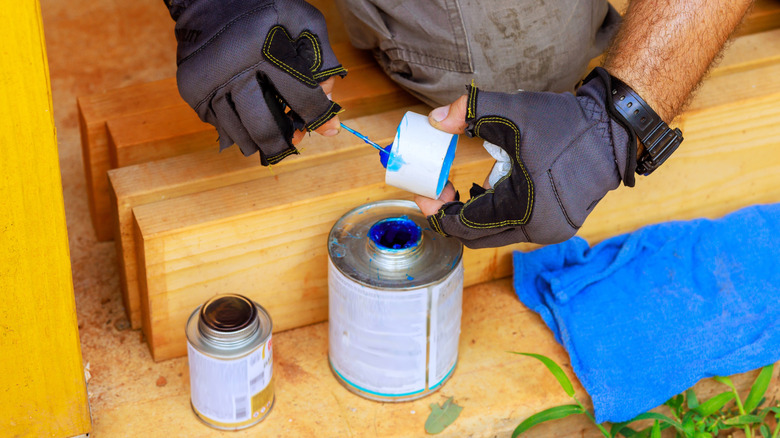
One of the big "secrets" in plumbing seems perfectly obvious once you finally realize it: The pipes don't fit together for a reason. This applies to a lot of plumbing fittings, and of course, it applies to PVC freshwater and drain/waste/vent pipes as well. If you find yourself trying to connect two plastic pipes of slightly different diameters and different colors, start paying attention. Chances are you're dealing with two different materials. For leakproof plumbing, the primer and adhesive cement you use should correspond to the materials you're connecting together.
In the PVC solvent section of your local big-box home improvement store, you'll find eerily similar cans of glue, cement, and cleaners designed for completely different products. These are usually PVC and CPVC (and occasionally ABS as well.) And as similar as their names are, PVC and CPVC, which can handle higher-temperature water, are chemically different and require chemically different solvents.
Selecting the right glue for your project isn't difficult; it's just a matter of understanding the material you're working with and paying attention to product labels. Pick the cleaner, cement, or glue for the application you're working on, the materials you have, and the weather conditions. Pay attention to temperature and humidity requirements (guidelines should appear on the product label.) Some PVC adhesives are designed to work with wet materials, and some will only bond properly to dry pipes. Finally, use the right viscosity. Use a more viscous cement for large-diameter pipes and systems that will be under pressure.
Types of PVC and CPVC adhesives
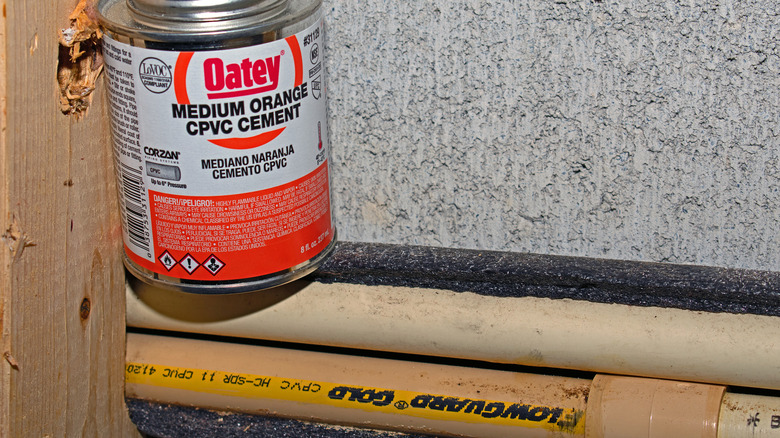
From the very beginning of your project, it's critical to understand those basic differences between PVC and CPVC pipe, as well as what a cleaner or primer is and the distinction between solvent cement and glue. Primer is specific to the formulation of the pipe you're joining, and cleans and prepares the surfaces to be glued. It's necessary if your adhesive calls for it. The adhesive itself, often casually referred to as "glue," might also be a solvent cement. Two PVC surfaces are connected by the glue and whatever properties it brings to the table. Solvent cement basically dissolves the PVC surfaces, allows them to interpenetrate each other, and then re-solidifies into a single surface that's chemically joined and is often stronger than the pipe itself, and far stronger than glue.
Most products are formulated for one of PVC, CPVC, or ABS, and their labels reveal any other characteristics you need to know about. PVC-only products include conduit cement, heavy-duty and fast-setting cements, one-step primer and cement combinations, cement for wet conditions, and highly specialized products like PVC shower pan liner cement. Both CPVC and ABS will, of course, have their own primers and cements, and some products are designed for two or more types of pipe, like primers designed for both PVC and CPVC and primers and cements designed for all three.