

Turning Off The A/C When You Leave To Save Money? Here's Why You Should Stop
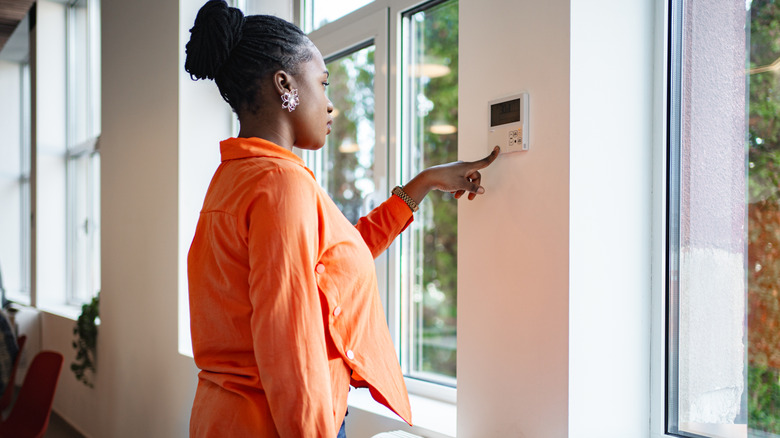
Keeping your house cool is not cheap. According to the U.S. Energy Office, 6% of residential electricity in the U.S. goes toward cooling home spaces – costing about $29 billion a year. With rising energy costs, it is tempting to turn off your air conditioner when you're not home, either when you're at work during the day or when you're away for a longer period of time. You're not illogical in thinking so. Why spend money cooling your home when you're not there? The longer you're away from home, the more this may make some sense. But on a daily basis, the opposite is often true. If in the summer you turn off your A/C when you leave for work, you're going to return to a hot home later in the day and then crank up the A/C to cool it back down. That's going to take more energy than if you had just left the air conditioner running.
There are a few other reasons to keep your A/C on when you're away. The recommended level of humidity is based on the temperature in your house. If it's going to be very humid while you're away, leave the A/C on. Persistent humidity is one of the leading causes of mold growth in your home. Air conditioners double as dehumidifiers, removing moisture from the air and thus lowering the possibility of mold or mildew developing or moisture damaging your furniture. Returning to a hot and humid home also means it's harder for your body to remove heat by perspiration. And if your home is poorly insulated, it's less able to retain the cool air you've created by running the A/C. By contrast, if your home is tightly insulated, you're more likely to return to a cooler home without the A/C running while you were away.
Best ways to lower your A/C bills and still keep your home cool while you're away
There's a middle ground between turning your A/C off or leaving it on full blast. Turning your air conditioning a few degrees higher when you leave means it doesn't have to start all over when you return home. Cooling down an overheated house can take roughly 20% more energy than it does to maintain a constant temperature over the course of several hours. As a result, merely adjusting your thermostat a few degrees higher when you're not at home can save you up to 10% on your electricity costs – around $150 – a year. A smart thermostat will do that for you automatically rather than you having to adjust it every time you leave the house.
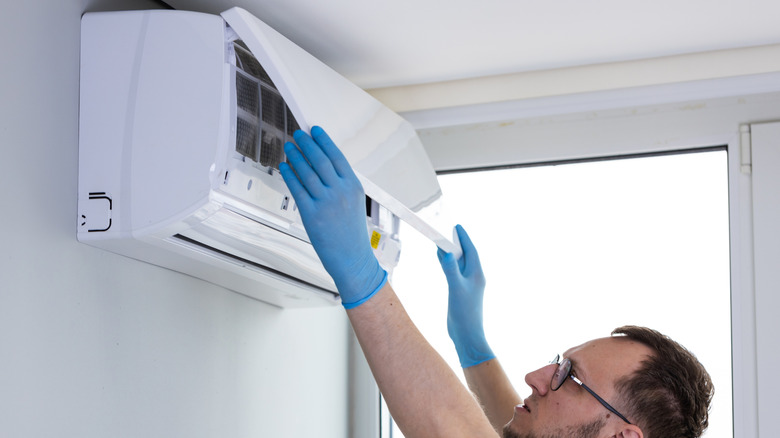
There are other ways to use your A/C more efficiently so that it doesn't have to work as hard to maintain a cool temperature while you're away. Cleaning the air filters and replacing them periodically removes obstacles to the circulation of air, meaning your A/C unit doesn't have to work as hard to cool your home. This can reduce your A/C's energy use by 5% to 15%. And if it's time to replace your aging air conditioner, look for a more efficient way to cool your home. This can save you 20% to 50% on your A/C energy use. Central air conditioning and air-source heat pumps have the highest efficiency ratings, but window air conditioners can vary widely in terms of efficiency. Installing an air conditioners rated SEER 14 rather than SEER 9 can save you 35% on your monthly cooling costs.