

Help Your Roses Thrive And Bloom With A Natural Remedy From Your Bathroom
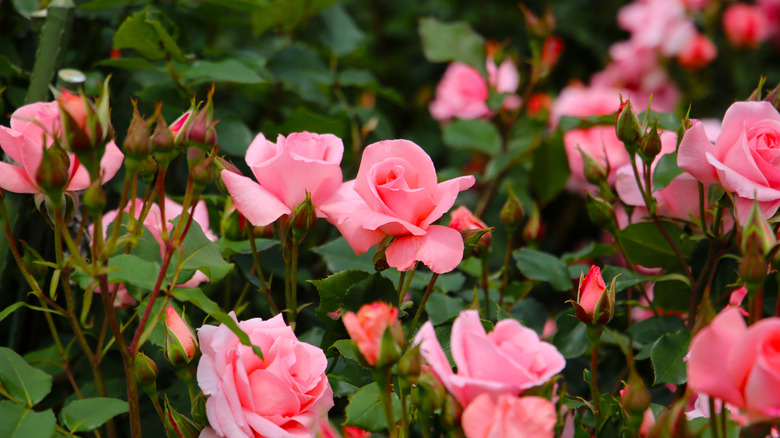
Roses are heavy feeders. To produce all those beautiful, long-lasting flowers, roses need lots of nutrients and a healthy, well-balanced diet of both macronutrients like nitrogen, potassium, and phosphorus, as well as micronutrients like zinc, iron, manganese, calcium, sulfur, and magnesium. Knowing how to grow and care for roses not only means watering, pruning, and protecting them, but also regular fertilization so that the soil doesn't lack any of these essential nutrients. You can buy and apply general fertilizers for all-around nutrition, but if your roses seem to have weak stems or yellow leaves, they could be short of magnesium. If that's the case, you might try using Epsom salt as a fertilizer. Don't just run directly from your medicine cabinet to your garden, however: use it wisely and only if needed, otherwise you might be doing more harm than good.
Epsom salt is magnesium sulfate — magnesium and sulfur — two key ingredients for plant growth. Your roses, however, may have a more general nutrition issue. Especially if you've had your roses drawing nutrients from the soil for many years, you might need to add a general fertilizer or top-dress the soil with compost to provide the well-balanced meal that your roses need, including magnesium and sulfur. If you simply give your roses a dose of Epsom salt when your soil isn't necessarily short of magnesium, at best, the water-soluble Epsom salt is just going to end up washing away. At worst, as with humans, too much salt in their diet can have a negative effect: Salt can accumulate around plant roots and inhibit their growth. Learn how to use this natural supplement properly, and you can keep your roses happy and healthy.
What can Epsom salt do for roses?
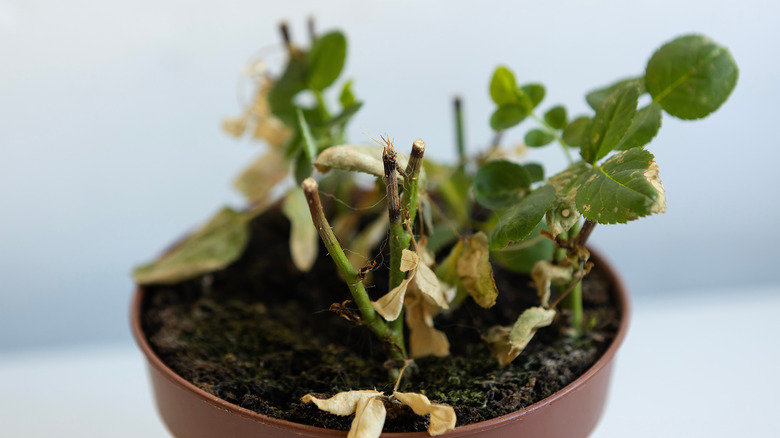
Magnesium is a key component of chlorophyll. It's no wonder that a lack of it can result in yellow leaves, as plants cannot photosynthesize without it. Magnesium is also important for the development of cells, because it helps plants take up nitrogen, phosphorus, and sulfur.
There are an infinite number of websites advocating Epsom salt on a whole variety of plants, but more scientific studies of the effect of magnesium sulfate on roses is needed. A paper presented at the 5th International Conference of Modern Technologies in Agricultural Sciences in 2024 found that magnesium sulfate improved the health of branches and flowers, yet James Schmidt, Extension Specialist at the University of Illinois, believes that just the opposite: "Though many gardeners use Epsom salt, magnesium is not a major element for plant growth, so having a healthy soil and supplying nitrogen, phosphorus, and potassium is most important and it does not replace those elements."
Magnesium deficiency is often the result of soil being too acidic, which inhibits plants' ability to take up magnesium, which in turn makes it more difficult for plants to take up nitrogen, phosphorus, and sulfur. When magnesium is not deficient in soil, adding Epsom salt to roses has a negative effect: Stems are fewer and flowers aren't bigger or more numerous. When magnesium is deficient, adding Epsom salt can help your roses thrive and bloom. The key to determining if your roses need Epsom salt is testing your soil. You can purchase inexpensive soil test kits to see what nutrients are lacking. Be sure to test your soil's pH level, as adjusting your soil's pH might be a key hint that your roses might need a shot of Epsom salt.
When and how to treat your roses with Epsom salt
Roses are acid-loving plants, but only slightly. If it turns out your soil is too acidic, there are short-term and long-term ways to help your roses thrive. The longer-term solution is to reduce the acidity of your soil. There are a number of methods to adjust your soil's pH, including by adding calcium. More generally, you can top dress your roses with a compost mulch, which, together with a small amount of Epsom salt mixed into the compost, can over time, balance out your soil's pH.
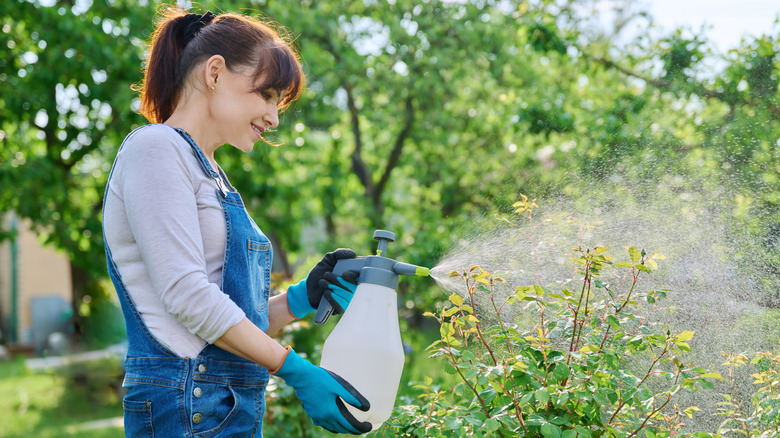
But to help your roses in the short term, an application of Epsom salt is a quick way to give your roses the magnesium it needs. Sprinkle a ½ cup of Epsom salt around the base of your roses in early spring. A foliar spray is also an even more immediate way to get magnesium into your roses. Dissolve one tablespoon of Epsom salt into a gallon of water, then add the solution to a spray bottle. Spray it directly on your roses' leaves rather than into the soil. Do this early in the spring, as the plant begins to produce buds, and after a rainstorm if needed.