

How Hydrogen Peroxide Can Make Your Houseplants Thrive

Remember when you scraped your knee on the playground as a kid, and the school nurse applied some hydrogen peroxide before covering up the wound with a bandage? Today that's no longer recommended, as it can cause cell damage and slow the healing process. There are still many uses for hydrogen peroxide as a disinfectant and general household cleaner, but it's also surprisingly effective at helping houseplants grow, stay healthy, and look their best.
Add an extra 2 at the end of H2O (water) and you get hydrogen peroxide (H2O2). That extra atom of oxygen is the key to hydrogen peroxide's magic, turning simple water into a highly reactive compound. Oxidation is that reaction, and it's what turns iron into rust, tears apart germ molecules, kills fungi, and cleans surfaces. Too strong a reaction is not a good thing, however. A highly concentrated solution of hydrogen peroxide can be life-threatening, which is why the solution available for purchase at your pharmacy is usually only 3% H2O2. Hydrogen peroxide used for industrial purposes can be much higher.
How hydrogen peroxide improves plant health
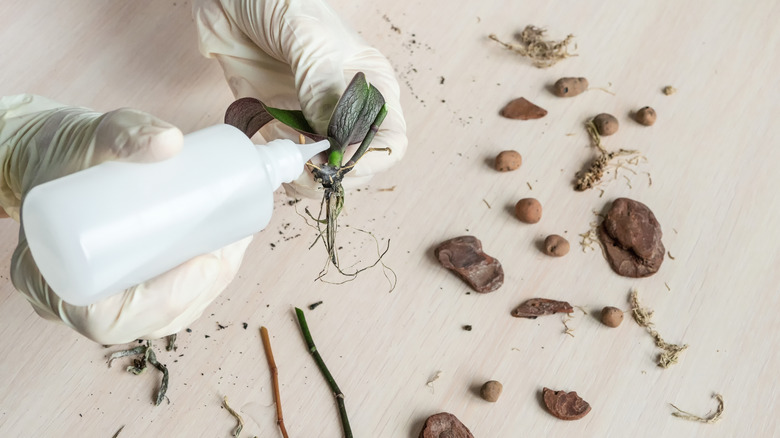
Hydrogen peroxide works the same way on houseplants as it does as on household surfaces: it disinfects, allowing plants to resist diseases. H2O2 has been shown to help pepper plants and cassava plants fight off infections. Hydrogen peroxide also improves seed germination. Soaking chili seeds and zinnia seeds in hydrogen peroxide reduced levels of harmful fungi without reducing germination rates. The same applies to bulbs and tubers: You can disinfect them if you're forcing them into dormancy for growing them indoors. And after trimming back your overgrown houseplants, you can treat their wounds with hydrogen peroxide to protect them from infection and help them heal.
Rainwater frequently contains significant amounts of hydrogen peroxide, but it doesn't rain indoors, and indoor air can often be drier than what's outdoors. Periods of high heat can also stress plants. Hydrogen peroxide can enhance plant health by improving photosynthesis and pigment production, making leaves appear greener and more vibrant. Some studies also suggest it may influence nutrient uptake, though evidence for a direct effect on nitrogen absorption is limited. Its benefits are more clearly tied to boosting overall growth and stress resistance than to increasing nitrogen use specifically.
How to use hydrogen peroxide on houseplants
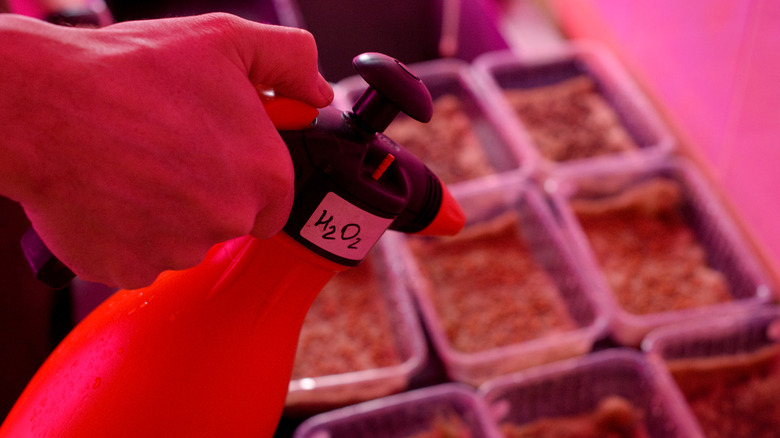
The key to using hydrogen peroxide on houseplants is knowing how strong a solution you should use. You'll likely want to dilute the 3% solution that you bought at the pharmacy even further — down to 1%. (Simple math: to dilute a 3% solution to 1%, simply add twice as much water as hydrogen peroxide before applying it on plants.) The study on cassava mentioned above used only a 1% solution. The study which soaked chili seeds found that a 3% solution produced the best results for killing fungi. Your results may vary.
By contrast, the study of zinnias used much higher concentrations – 6% and 9%. As with humans, too much hydrogen peroxide can have negative consequences. The study of zinnia seeds found that any concentration higher than 9% reduced germination and plant health. Since hydrogen peroxide is a potent chemical compound, start with a 1% solution, test your results, then strengthen the concentration if needed, especially if your plants are still young.
If you're growing your own houseplants from seed, you can simply soak the seeds in an H2O2 solution anywhere from 20 to 60 minutes. If using a solution higher than 1%, limit the amount of soaking time so that you don't do more harm than good. If you want to treat your mature houseplants with hydrogen peroxide to kill powdery mildew or other fungi, add your diluted solution to a spray bottle and spray the leaves.