

The Deceptively Beautiful Blue Flower You'll Wish You Never Planted In Your Yard

There's a certain allure to including blue-hued flowers into your garden or yard; they evoke a sense of fairytale wonder and stand out against greenery in the best of ways. And while some blue blossoms like hydrangeas need a certain level of care and finesse to grace us with brilliantly colored blues, other plants are so prolific that they're incredibly easy to grow — sometimes too easy. This is true of Spanish bluebell (Hyacinthoides hispanica), a rigid-stemmed perennial flower known for its clumps of lavender-blue, bell-shaped blossoms. Hardy in USDA Zones 3 to 8, Spanish bluebells are originally native to southwestern Europe, however, due to their invasive nature, you'll want to steer clear of them in the States. It's a deceptively beautiful flower that you'll wish you never planted in the garden.
Spanish bluebells establish very easily and will get weedy relatively quickly. They are able grow up to 20 inches tall, with 1 1/2 foot wide spreads, large enough to take over yard spaces as they do forest floors, where they commonly serve as ground cover, albeit an invasive one. When these bluebells take root in an area, they tend to outcompete other flora, damaging both natural landscapes in the wild as well as your carefully curated garden. Additionally, these plants are incredibly toxic if ingested, and can even cause topical irritation since most parts of the plant — the sap, the stems, the flowers — are poisonous. Unfortunately, this variety of bluebell is difficult to eradicate, making it an even less desirable squatter in the yard.
How to eradicate Spanish bluebell
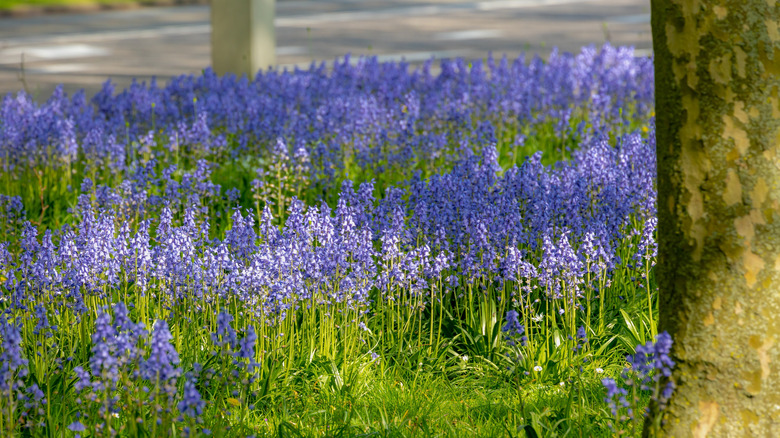
As mentioned, Spanish bluebells can infest yards, particularly because of how they grow. Propagated naturally from both bulbs and seed, it's difficult to merely dig them up since some of the bulbs can be quite small, not very obvious, and buried deep in the ground. Digging up the bulb is one of the more common ways to get rid of the flower, but since it's likely some bulbs may persist even after such excavation, you'll need to be prepared to do this digging ritual on an annual basis. This plant is also resistant to even the best weed killers, rendering another popular method of handling invasive species effectively useless.
One method of eradicating Spanish bluebells is to starve them by cutting off the tops of the plant every couple of weeks or mowing lawns and yards where bluebell clumps are present. This, of course, requires you to regularly dedicate time and elbow grease to the garden. Laying turf over bluebell patches is another solution to smother the plants, but this idea can get pricey depending on the desired pile height, density, and material of the chosen turf. Others have even attempted to burn these wildflowers away, which comes with its own challenges, particularly in times of drought or dryness. At the end of the day, the answer to removing this invasive blue blossom is consistency and persistence, whether you choose to dig the bulbs up or regularly mow them down.
Flowers to plant instead of Spanish bluebell
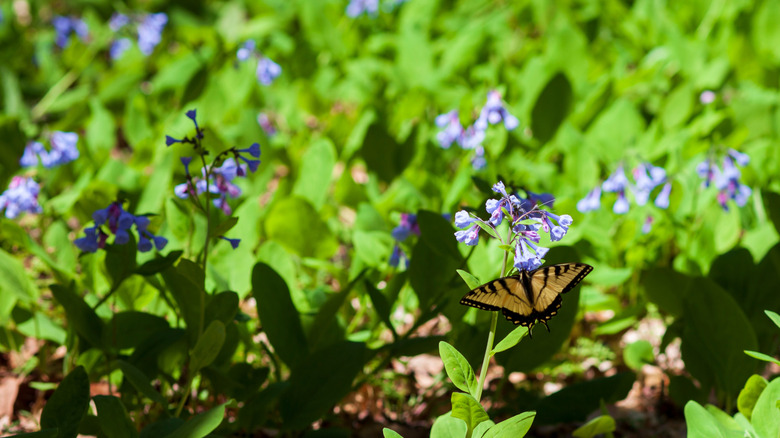
Save yourself headache by opting for blue flowers that won't invade into other parts of your yard. You may also want to look towards native alternatives. The closest native replacement for Spanish bluebells, for instance, is the Virginia bluebell (Mertensia virginica), a plant indigenous to eastern North America. Similar in color and shape with the same sort of distinctive dropping, trumpet blossom, Virginia bluebells are hardy in USDA Zones 3 to 8 and can grow up to 2 feet in height, much like their Spanish counterparts. It can be found as a native wildflower from the Midwest up into parts of Canada and as far south as Alabama. Unlike its Spanish cousin, though, Virginia bluebells do well when interplanted with other flowers for ground cover. They also take their time to bloom, sometimes needing several years; all in all they're more delicate than Spanish bluebells, which takes the infestation variable out of the equation.
Another native perennial alternative to Spanish bluebell is blue sky aster (Aster asureus). Hardy in the same zones as bluebells, these purple-blue flowers can grow up to 3 feet tall in the garden and spread up to 2 feet. Another self-seeding plant, blue sky aster spreads via rhizomes. Don't worry though, this aster variety doesn't infest yards quite like Spanish bluebells; it's easily manageable, and cutting the flowers back will stop and maintain its crawl. A fall bloomer, blue sky aster decorates your garden well after other summer flowers, brightening up your yard even as the weather cools. While there are many blue flower alternatives to Spanish bluebells, the biggest tip here is to grow native plants when you can.