

Still Using CFL Light Bulbs? Here's Why You Should Stop

Compact fluorescent light bulbs (CFL) were born during the oil crisis that began in 1973. They became popular by the 2010s, when concerns about energy efficiency as a way to combat climate change rose and federal regulations required more efficient light bulbs. CFLs are indeed far more efficient than traditional bulbs, but there are even more efficient bulbs that have made CFLs obsolete. Money-saving interests alone should give you reason to stop using CFLs. Concerns about the safety of CFLs should make you concerned about what to do with them after you stop using them.
Lighting accounts for about 15% of an average home's electricity use. With the average monthly electric bill of $136.84 in the U.S. in 2023 (per the U.S. Energy Information Administration), that's over $20 a month spent on lighting alone. A CFL can produce the same amount of light as a traditional incandescent bulb but use 75% less energy and last 10 times longer. The switch was an obvious one from a financial point of view, though not everyone liked the screw shape of some of the bulbs.
Then along came light-emitting diodes (LED) bulbs, which last four times longer than CFL bulbs (and 25 times longer than incandescent ones). You can put an LED light bulb on a dimmer switch, and LEDs are cool to the touch, unlike CFL bulbs. It was the case of one new technology replacing another, like smartphones replacing cellphones which replaced landlines. Today, LEDs provide half (48%) of lighting in homes, double what CFLs provide. From an energy efficiency perspective, CFLs are going the way of the film camera and movies on DVD. It's time to stop using them and switch to LEDs and here's why.
CFLs contain small amounts of mercury
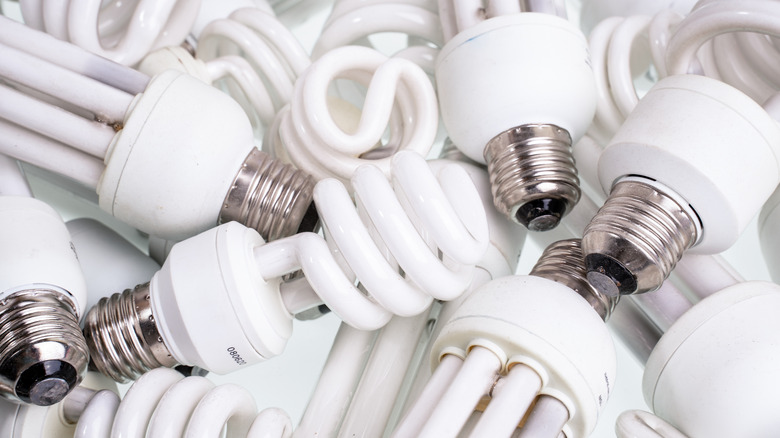
If financial reasons aren't enough, consider the risk of toxic exposure from CFLs. There are small amounts (about four milligrams) of mercury in compact fluorescent light bulbs, which is necessary for the way they generate light. Ironically, perhaps, the adoption of CFLs has led to a reduction in the amount of mercury released into the environment. Coal-burning power plants produce some 40% of mercury emissions in the United States, so in regions of the country where electricity is generated by coal, switching to more energy-efficient CFLs has resulted in reduced mercury emissions (as well as reduced carbon emissions).
Four milligrams is a minuscule amount compared to the 500 milligrams of mercury in older thermometers. Still, when CFLs break, the mercury is released into the environment, which can be extremely toxic if inhaled. Concern about mercury poisoning was one of the reasons for reluctance to adopt CFLs in the 2010s – and one of the reasons people have more recently switched to LEDs, which contain no mercury. Why keep using CFLs and run the risk of mercury poisoning to you or your family?
What do you do, then, with those mercury-containing CFLs once you've stopped using them? Many states ban disposing any fluorescent bulbs to landfills. Some even require recycling. (You can search Earth911.com to see if yours does.) But sadly, only 2% of fluorescent bulbs are currently recycled by consumers. With CFLs making up a quarter of all the 6.5 billion lighting units in the U.S., that's the potential for over 6 billion milligrams of mercury (over 6 tons) ending up in landfills, leaching into waterways, being consumed by fish, which are in turn consumed by humans. It's time to stop buying CFLs and adding to that frightening figure.