

The Harbor Freight Tool You Should Consider If You're Installing A Fence Yourself

A homeowner's first thought when pondering a new fence or a miniature orchard of fruit trees is, "That sure would be lovely." The second thought, of course, is "but that is a lot of holes to dig. Maybe next year." What this situation calls for is one of the best DIY landscaping tools ... one that most homeowners would love to have, but might not even consider: a garden auger, the truly fast and easy way to dig a post hole. And Harbor Freight sells a fairly affordable one.
A garden auger is a small earth auger, a gas- or electricity-powered drill designed to create holes in the ground (and a few other things) with far less effort than digging by hand with a shovel or a manual post hole digger. It looks like a giant drill bit (the auger bit) with a motor on top (the powerhead) designed to be held up and operated by one or two people, depending on the overall size of the rig. The spiral shape and deep flutes of an auger bit are designed to dig easily and remove material efficiently without having to constantly pull the bit out to clear the dirt you're displacing.
Harbor Freight's Predator gas-powered earth auger at a price point of $224.99 (at the time of this writing) is just about perfect for the usual lawn and garden uses. Its two-horsepower, 52 CC gasoline engine sits atop a 6-inch diameter, 31-inch-long bit built for digging. The device's weight is listed at 20 pounds, which is probably only the weight of the powerhead itself. At 102.4 dB, it's about as loud as a motorcycle.
It gets the job done, usually
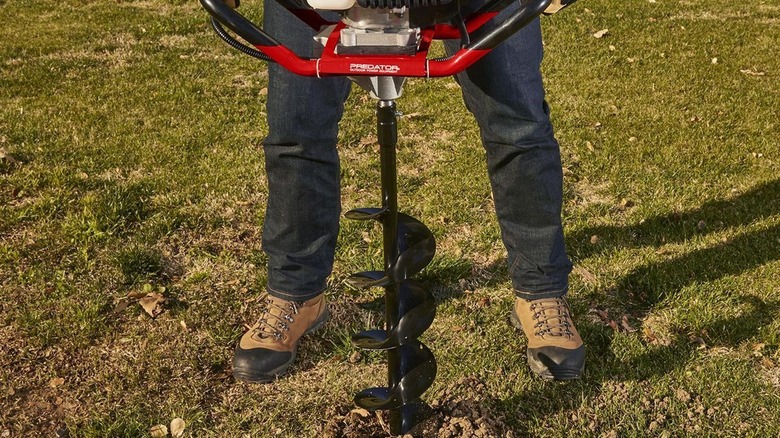
Of course, a tool's raw specifications aren't always very informative without some context. The Predator auger produces 45 ft-lbs. of torque, within the usual range for augers with 52 CCs of engine displacement, and certainly nothing special. We looked at a few different sorts of retailers that sell earth augers in most areas of the country, mostly paying attention to gas and electric powerhead augers that were either in stock locally or could be shipped to a home or store within seven days. For various reasons, we ignored ice augers, tractor-mounted augers, and other specialized versions. The Predator's 45 ft-lbs. turned out to be a common value, but the lowest torque rating for augers with around 52 CCs. Not bad, and not spectacular.
Harbor Freight also sells an eight-inch auger bit for the Predator, as well as a 2-inch pilot bit and a 21-inch shaft extension. Technically, even the 8-inch auger bit would be a little anemic for digging holes for ordinary 4-inch round or 4x4 posts, which would require a 10.5-inch hole using the standard rule of thumb. The 31-inch depth of the two Harbor Freight bits is a little shy of the common range of 36-48 inches. A 31-inch length suggests that your post should top out at around 5 feet. This is obviously more important if your fence is meant to handle a great deal of tension (say, a wire fence, rather than wood). But on paper, the Predator is a perfectly serviceable garden auger that should turn an afternoon of digging into a half-hour of auguring.
A few potential problems to be aware of
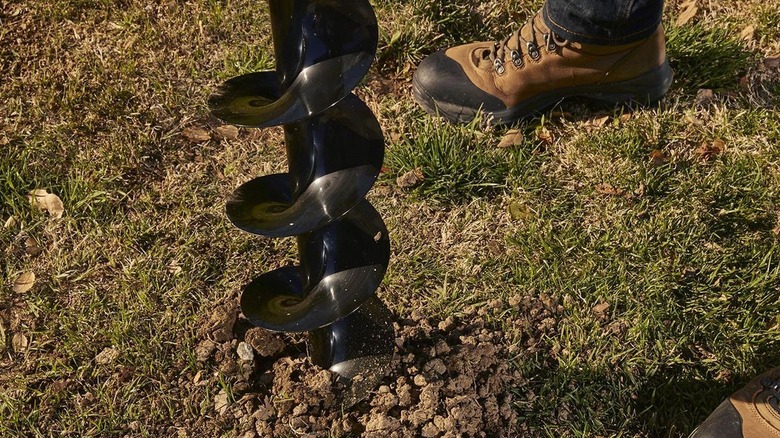
A small percentage of reviews on the Harbor Freight website hint that you might spend an afternoon trying to start the Predator earth auger when you should be digging with it. One user reported that the choke's mechanism was labeled backward, which would interfere with starting and running. But relatively few users complained about starting, and there's a good chance the problem is user error, which is also true of complaints that the engine won't ever run again after a lengthy first use. While that could be due to manufacturing defects, there's another possible reason. The Predator auger uses a two-cycle gasoline engine that requires a specific gas-oil mixture to work properly. But the website isn't super-clear about this requirement, and it's possible the product packaging isn't either. Running a two-cycle engine without oil in the gas is the destructive reason tools like augers and weed trimmers overheat. The resulting heat would also explain why a few noted that the plastic shroud over the muffler melted. A handful of reviewers noted problems with the machine's power, especially in clay soil and hard-packed dry soil ... probably the raison d'être of the aforementioned pilot bit.
None of these possible compromises is a deal-breaker, assuming there's a deal to be had in the first place. That's what Harbor Freight is famous for, right? The Predator was the 11th cheapest of 26 models we examined, and Walmart, Lowes, and Tractor Supply all sell cheaper augers with similar capabilities. In the end, your decision might come down to which store actually has a suitable model stock when you need it.